Epictober 2011: Experiencing Pakistan - Post 8 of 8
The warm welcome was followed by some really quick service by two new waiters. The plastic table gleamed under the orange light as one of the waiters wiped it clean with a small cloth; the next moment, plates and cutlery were neatly spread over the table by the second waiter with the addition of complimentary salad. I pulled my traditional pakol cap further down on my head to feel more comfortable in the mild, chilly wind and felt a sense of solidarity and warmth among all the laughter and talk surrounding me.
The whole story in the past few posts has taken its time; this is my last post which caps off my travels of Pakistan last October. A nomadic experience of a month with work as well as cultural and exploratory experiences in new places left me with loads to choose and write about, hence most of the delay. Just hope the stories are worth the delay. :)
“Pakhair Raghla!” The only thing I managed to learn in Pashto during my stay in Peshawar. The Suzuki Bolan sputtered to a stop at the side of the road and the driver killed the engine. A rich aroma swept into my nostrils as I stepped out into the cool, late October wind. An orange glow from a row of hanging bulbs drew the boundary of the restaurant’s dining area with an aura of light, which faded with distance from the few tables in the area. The sound of loud chatter and laughter came from the occupants of most tables, mixed with the soft chinking and clinking of cutlery. Chefs sat on their knees on an elevated platform, baking nan in the tandoor and grilling other food. Another chef stood next to the platform, frying food in a large pan.
One of the staff members walked toward us from within a thick, white cloud of smoke emanating from the open air kitchen. “Pakhair Raghla!” he said in Pushto, shaking hands with all four of us. One of my colleagues, who knew Pushto as well, conversed with him as we were directed to a table for four. The waiter, upon learning that I had come all the way from Karachi and had stopped for a meal at his restaurant, shook hands with me again more energetically and said, “You are our guest tonight, and we shall treat you to one of our specialties of Peshawar.”
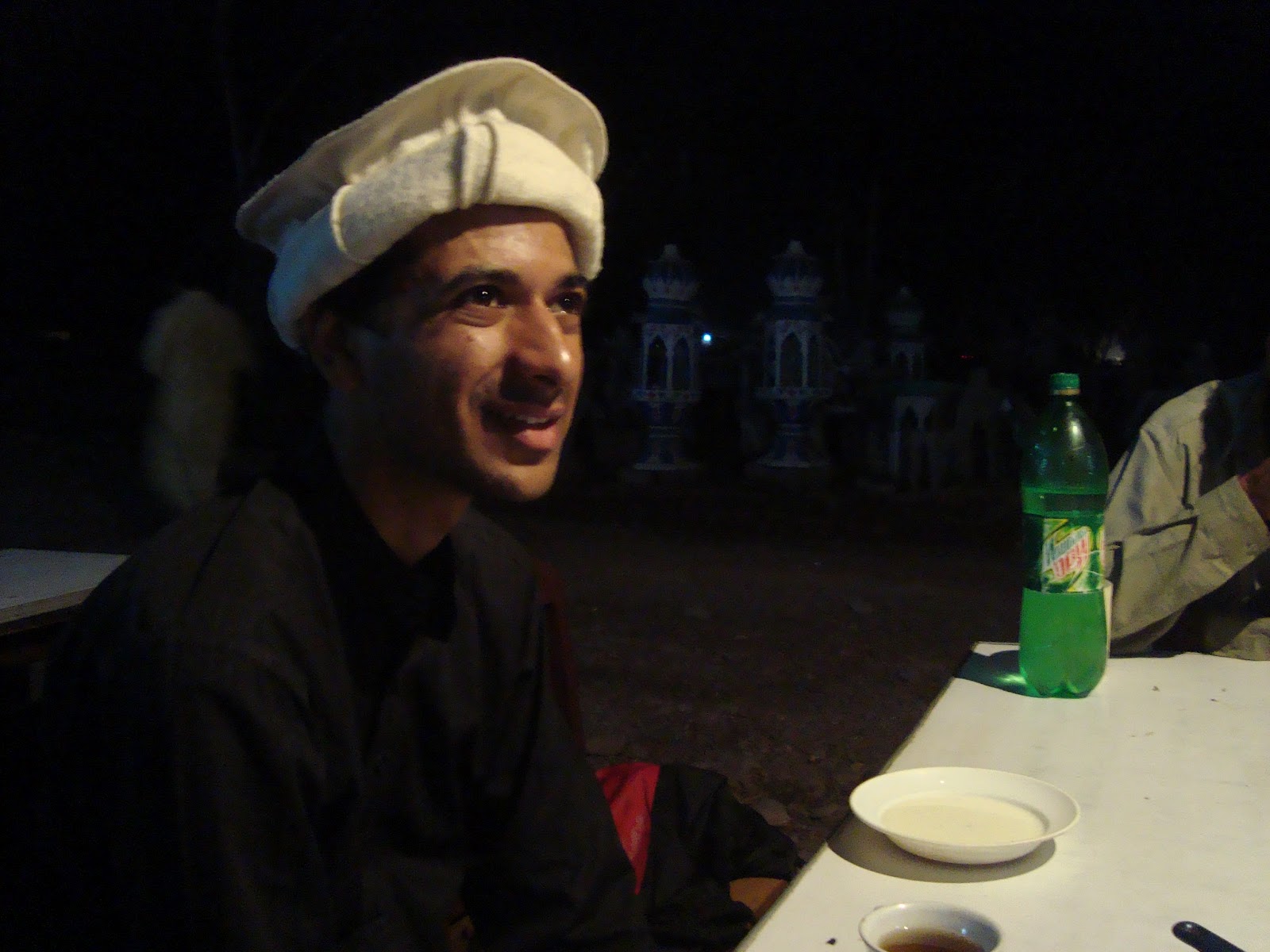 |
| Blending into the culture on the first night in Peshawa |
Within a few minutes, our table was laden with chappal kababs, a full pound of greasy, lamb and beef patties, served with some, buttery, Kandahari nan. The aroma that wafted from the cooking area was suddenly more pronounced, and we all gave in to the temptation as it overwhelmed us. Even though I have tasted nan and chappal kababs at home in Karachi, but the ones I tasted in Peshawar were a class apart. The meat was juicy and tender, and the kababs had just the right amount of spice; add to it some crispy, white nan, and I had one of the most unique dinners during my stay on the road.
Following local tradition, my Peshawari colleague suggested a cup of kahwa after dinner referring to its importance in cleansing the throat and helping in digestion especially after a heavy, fried dinner. He eagerly called for the waiter again as I reluctantly agreed to the offer, and ordered four cups of kahwa in Pushto. Although their talk was incomprehensible, a regretful expression on the waiter’s face and the disappointment in my colleague’s voice alerted me to a problem. My colleague turned to me and said, “they do not have kahwa on their menu.”
The waiter looked at me for a moment, then exclaimed to my colleague in Pushto and left with a determined look on his face. As he motioned another waiter to come quickly, I asked my colleague what was happening. In a pleased and proud tone, he replied, “he honors our traditions and has agreed to make kahwa for us especially since you are a guest from outside the city. He just asked someone to get the ingredients for kahwa from outside.”
It was an immense surprise to learn this fact as no restaurant I had ever been to around the world had ever gone so far in providing customer satisfaction. In about fifteen minutes, a transparent, crystal-green tea was served to us in glass cups. The herbs and sweet scent that emanated from it exhibited an extra sense of care and homeliness offered to a traveler. I had held a very apprehensive image of Peshawar before arriving there, and had imagined the people to be sharp, hostile and highly critical of outsiders. Sip after sip of the hot, sweet kahwa spread warmth inside me which opened up my opinions about Peshawar; the traditional pakol cap I was wearing along with my black shalwar kameez helped me feel at ease and at one with the locals. Such unprecedented hospitality, value for traditions and immersion in culture gave me just a glimpse of what Peshawar was about during my first night there.
As I opened up to embrace the city, it started to reveal its many secrets and stories, long neglected and overshadowed by the recent presence of terrorism in the neighboring areas and the more progressive nature of other major cities in Pakistan. Peshawar holds the title of being one of the oldest cities of Asia, and was thriving long before Lahore and Delhi. Akbar the Great formally gave Peshawar its present name, which in Persian means “City on the Frontier.” Peshawar used to be the connecting hub to Central and South Asia along the ancient Silk Road from Persia in ages past.
 |
| A market square in Bara Market, Peshawar |
The next few days were followed by the pitter patter of rain drops in Peshawar. On a gray Sunday morning, my colleagues took me to visit the famous (or infamous) Karkhano Market, also known as the Bara Market. The well paved city roads eventually gave way to a slightly rougher track which was busy with traffic of huge cargo trucks. Eventually, many market squares started coming up on the right, open spaces covered with shops on three sides and a path on one side which led from square to square. Every market square carried a different category of products: electronics, cosmetics, clothing, dry fruits, groceries, and so on. Many hawkers ushered us to their wares set up in the open plaza close to the main shops.
As we walked on the wet ground after a morning downpour, my colleague told me about the market, “Right now we are close to the city border of Peshawar. The market continues beyond the border but there is a security check post situated near the last plaza within the city boundary. This is recent because of the continued security concerns in Peshawar.”
I jumped over a large, muddy puddle in the way, and then went back all ears to listen more closely. He continued, “This market forms a major trade link between Afghanistan and Pakistan, where many wholesalers and distributors transport goods to Afghanistan. The area of FATA starts just a kilometer or so from here and the famous landmark of Baab-e-Khyber, the archway which marks Khyber Pass is about a fifteen minute drive from where we are. The trucks load up with goods and head that way towards Afghanistan.”
“How far away is the actual border from here?” I asked, my curiosity escalating. We stopped at a shop where one of my other colleagues was looking for a good camera to buy. My Peshawari colleague, distracted for a moment by the camera choices on offer, replied, “From where we are, the actual border is about a forty five minute drive, a place known as Torkham. Between the Baab-e-Khyber and Torkham, there are tribal villages all around, which govern themselves mostly according to traditional laws which have been transcended by their elders over centuries. Many small traders from that area also get their wares from here.”
“Another interesting stop before Torkham in FATA is a border town called Landi Kotal. The town used to be a popular tourist destination until times got bad, and a train also goes there. Landi Kotal is famous for its food, hospitable albeit rugged tribal people, contraband and arms shops,” he explained. Images of a new Wild West floated in front of me with tribal people in 4x4 jeeps with their AK-47s. “It is the highest point of the Khyber Pass from where you can have a view of Afghanistan below you toward the west, just before the road descends into Torkham. Then the nearest Afghan city of Jalalabad is about two more hours from the border. I would have taken you to Landi Kotal but it’s not safe these days.”
A sense of that “it’s-a-small-world” feeling overwhelmed me as I wondered how close I was to a different country and engulfed in their culture. The market was buzzing with scores of people, traders as well as shoppers, who flooded the market around us. An old man with a large, round tray on his head went about selling dry fruit; women in burqas haggled with shopkeepers over their wares and a shop selling audio systems put on Pushto music to give a demo to his customers. Over the din of the loud, lively melody now filling the entire market square, my local colleague pointed out some of the second-hand and counterfeit electronics on display. “One needs to be careful of what they buy here though. This is a market without many regulations, and a lot of goods end up here. Some people find record bargains here, but mostly people end up selling their used electronics in this market, which are put on sale again.” I struggled to hear his voice over the loud beats of the rabab music which was now attracting excited expressions on passing faces, “A lot of goods which are supposed to go to Afghanistan end up back here instead of completing their journey because there are no real checks in FATA.”
“I expected some really good bargains and interesting deals here on things like cameras,” I joked, referring to the mostly below average merchandise on display. My colleague responded in a challenging way, “Alright then, let me take you to another part of this market if you want to see something really interesting.” Intrigued, my other colleagues and I followed behind him through the pathway that joined all the market squares. It started raining once more, and the hawkers lining the pathway adjusted the cloth covers that formed the roofs over their little shops. As I walked, trying to avoid the fresh puddles forming on the ground, orange light bulbs came on in the darkening street. Their glow highlighted the diverse wares behind them which were hidden in shadow due to the darkness of the day. We approached a place filled with the sizzling sound of samosas in a frying pan and the wafting smell of fresh tea, the crowd of shoppers thickened and I struggled to catch sight of our guide ahead.
Breaking through the throng of lively shoppers enjoying a midday tea break, we joined our guide in a new market square. His eyes shone with a secret which he seemed eager to share with us, “You must have often heard on the news that NATO supply trucks get burnt and destroyed on their way to Afghanistan?” he questioned like a teacher who expected an affirmative from their students. We all nodded, and he continued, “Well, haven’t you ever wondered where all the stuff from those trucks ends up?”
We exclaimed and looked about. This market square did not have proper shops, but a lot of hawkers. Lined up on their shop curtains were military grade binoculars, daggers, shades, belts, boots, jackets, shovels, torches, compasses, and other equipment, all with the insignia and make of what seemed like US Marines and NATO. It was certainly not Pakistani. I was awestruck for a moment as I tried to take it all in. Finally, I mustered, “How?”
My colleague smiled at his checkmate move and said, “It’s all set up. The truck drivers are paid to leave the trucks peacefully with their contents when threatened. The stuff is ransacked, sold in this market and the FATA tribal people pay a share to the truck driver so he can keep his mouth shut.” I still could not believe it but the ample military grade equipment on display did not seem like an accident. Copies of the Bible, magazines, comics, and some manuals on battlefield tactics with the U.S Bald Eagle on them also lay in a carton.
 |
| Supposed military grade equipment salvaged from destroyed NATO trucks |
I went up to a hawker and tried to find something useful. A pair of Oakley shades, complete with extra lenses and a zipper casing, caught my eye. “Rs. 600 for this,” said the boy in charge. My colleague haggled with the boy in Pushto and played the guest-from-Karachi card to get me a discount. He agreed to two pairs of shades for Rs. 800, now that was a bargain, I thought.
Our guide took us a bit further and pointed a few meters ahead; some armed guards patrolled at a check post on the road. “Okay, so right now you are standing on the border of Peshawar and that barrier marks the start of FATA and the road that leads to Khyber Pass and on to Afghanistan.” I looked on in awe as he pointed to the pathway running between the market squares, “As you can see, the market continues beyond the Peshawar city limits.” I nodded after him; “This is the part where the rules of the market change significantly; from this point, everything from heroin, opium, hashish, AK-47s, M-16s, RPGs, Klashnikovs and any other arms and drugs you can think of are on sale freely.” My eyes widened with each item he named and left me grounded to the spot in shock. “But this is as far as we go,” he said, turning back.
But the fact that got to me most was the consistent hospitality offered by strangers, much more pronounced here than in other cities I had traveled to. Acquaintances we met during the day insisted on treating us for dinner and took it as an offence if refused without a valid reason. Over the coming days, we witnessed the pride held by Peshawar in its offer of a range of fulfilling culinary experiences. Stories of drug lords that run FATA’s opium trade told over delicious dinners filled with cheese-garlic nans and handis; and stories of the old and famous Namak Mandi and centuries old Qisa Khwani Bazar over a dinner of namkeen karhai were common.
Throughout the week, Peshawar continued to surprise me with its many such secrets, stories and cultural lore of old. Old fortresses, now used for military purposes and medieval architecture decorate the city. On another rain drenched evening, we were in a market close to the famous Sunehri Masjid. It holds a place in the relatively more recent history of Peshawar because its foundation stone was laid by Pakistan’s founder, Muhammad Ali Jinnah. Being in the vicinity, I decided to visit the landmark.
 |
| Inside the prayer hall of Sunehri Masjid, Peshawar |
It was dark that evening due to the cloudy sky, a premature dusk was filling into the hustle and bustle of Peshawar’s markets as the downpour ceased. The red stone and marble work on the Masjid walls shone bright in the lights that had been switched on earlier than usual. The Masjid seemed empty upon arrival save for a poor man sitting just inside the Masjid doorway. I went in and offered my Asr prayers in the main hall first before taking a look around. The main hall, empty save for a few worshippers, was dressed in white walls and rugged mats, a portrait of humility. The mihrab or recess in the wall was the exception which carried the signature red stonework of the outer walls, with elaborate white flowers and pillars carved in marble.
A fresh breeze was blowing in the well-lit courtyard as I walked out into the corridor from the main hall. The evening bout of rain had left the red courtyard surface with a glassy layer of water, which painted a clear reflection of the Masjid hallways and pillars on the wet floor. Peshawar’s beauty shone through that reflection, inverted red silhouettes of pillars against the hallway lights; a spectacle both grand as well as humble in nature. The secrets and traditions of the city revealed themselves in the inverted image; like a hidden window which opened up momentarily in a rare evening shower, just in time to offer a fleeting glimpse to a wandering outsider disguised in a traditional pakol cap and shalwar kameez.
 |
| Reflection of the Masjid in the wet, glassy surface of the courtyard |
The Masjid’s grand façade paid tribute to Peshawar’s age old form of architecture, part of a rich and unique culture often overlooked. The rain drops started pouring again, sending the beautiful reflection in the courtyard floor into a blur; the window closing again on Peshawar as I turned to leave. As I crossed the poor man who was still sitting in the doorway, I half expected him to ask for money but he sat by himself, with his back against the door, staring into the courtyard. Peshawar’s soul seemed lost and forgotten in the recent turmoil afflicting the region, yet its proud heritage, hospitality and rich traditions still stood strong. It's dark secrets also remained hidden in the blur raised by the falling rain drops.
 |
| The old man in the Masjid doorway. |
“Pakhair Raghla” was the only thing I managed to learn in Pushto during my stay. “Welcome!” They said. A welcome to an extremely hospitable place that challenged my stereotypes to the extreme and gave me an experience that offered multiple perspectives on life. My travels last October in all were a surprising and eye-opening “Pakhair Raghla” on their own, an introduction to my professional career that has me considering the ground impact of decisions in the workplace in a way I never thought I would. Four months from October now, a 360 degree impact of a decision in the workplace for me has taken an entirely new meaning, a meaning never experienced before graduation last summer. It has been an eventful “Pakhair Raghla” for me into the professional world and into the greater heart of Pakistan.


