Showing posts with label Road Trip. Show all posts

Wednesday, January 25, 2012

A Fool's Paradise

Epictober 2011: Experiencing Pakistan - Post 7 of 8

The truck art in Pakistan is a thriving culture on its own. If we pay close attention to the brush strokes on the metal body of a tanker or truck, we would notice mostly a stream, some green mountain slopes sketched in the back ground, a few trees and houses. A heavy yellow brush stroke often marks the sun, adding light and color to the sketch on the truck. Going through the busy city roads and traffic, that piece of scenery is strongly reminiscent of the art I used to draw back in primary school in my art class. The smiling sun I used to draw signified the nirvana of the perfect setting, a sense of calm and peace where life would look perfect. On the trucks that go through the major metropolitan cities of Pakistan, this art signifies memories of the mostly Pukhtoon migrants who come to work in the cities. The art they carry on their vehicles reminds them of the home, their perfect setting that they have left behind, and choose to carry with them wherever they travel. I never paid much attention to that art, but one needs to visit the mountains in the north to understand their sense of longing and what they left behind to make it to the big cities.
The view while descending into the valley
As our car swerved through a hard bend in the mountain road, and started its descent into a valley, that understanding finally hit me hard in the heart. Those paintings on the trucks, with all their fine details from the little houses, the trees, and the stream flowing far, far below had come to life. The road still turned and swerved with the mountain face we were driving on, but it took us gently down the green slope, closer to the heart of that beautiful valley. The green vegetation on the mountain slopes on both sides gave way to gravel and rocks near the banks of the blue stream. Its flow through the valley was ever so calm and graceful; it seemed to dictate the pace of life around it. Its influence stretched across the vast expanse of the valley, the landscape unadulterated by any signs of major human activity. The stream was below us on the right side of the road, and a point came where there was a good path for us to walk down to the bank.

Nature's true grace in a valley hardly touched by man
The car stopped, and the moment I stepped out, the sound of flowing water surrounded me. What had seemed like a calm torrent was actually raging fast and strong, raising white spume against the stones that protruded from the bed of the stream. The blue of the water changed to transparent crystal as I went and sat down on a stone on the bank, and even though it was moving fast, my excited reflection gazed back at me as I looked into the water. It was shallow, scattered with smooth, round stones at the bottom which faded from view towards the middle of the stream, where the white foam could be seen moving fast. My gaze went upwards, and beyond the farther bank, littered with more round stones, fields of green stretched upwards to the mountain slopes far away, marked with tall pine trees, all under a deep, blue sky.

Taking in the sights and sounds
As I sat on the large stone surrounded by water, I felt part of the unique audience of a surreal symphony surrounding me. The music started somewhere farther up north on a mountain I knew not, as it spilled its snows into the stream. The sloping relief further carved the tune as it cradled the water down the valley, and the stones and rocks placed at perfect intervals in the water channel weaved the full melody. Nature itself orchestrated the brilliant sound of the roaring stream, so beautiful to the ears that one needs to hear it in order to appreciate it. My front row seat on the stone was perfect, and as I sipped the cold water through my cupped hands, its purity filled my soul with tranquility. Far from the reaches of men and the world, the valley offered a moment of peace so sublime and heavenly; it was as if I had stumbled into paradise itself.

My three colleagues and I got up to say goodbye to the stream, and had a last look around. My eyes caught sight of three children playing on the bank a little way to our left. It was odd, because the nearest houses we had seen from the road were several kilometers away and they were alone. On our approach, they stopped throwing stones in the water and to my surprise, came to us with hands outstretched, asking for food. Beggars were common in the cities, but out here?

Three little strays playing near the stream

One of my colleagues noticed my reaction, and ignoring the little, outstretched hands said, “This area was hit hard by the earthquake in 2005. The nearby village of Balakot we are going to right now was nearly destroyed.”

He had built a little bridge out of stones
As I added one and one, I realized that these children must have grown in a world after the disaster took place, getting used to receiving help from the relief teams and outsiders who came here. All three of them seemed less than seven years of age. It was a half-hearted request, and without waiting for any sort of reply from us, the children went back to the stream. We went closer to see exactly what they were up to; one of them had had made his own tiny stream by making a channel in the gravel with a little bridge of stones going over the trickling path.

“This place has not been the same since the earthquake, and the construction of New Balakot, a town close to the original village has still not been completed,” my colleague said. “These people have merely been making ends meet here, and although things are better now, they are still not the same.”

Another colleague asked the kid what he was building, but he remained silent with a nervous look on his face. We left the kids near the stream and walked back up to the road. It was hard to imagine people not living in happiness in this piece of paradise, and looking back at the children, I realized it was their greatest irony.

We continued on the road to Balakot; we had begun from Mansehra earlier in the afternoon and had driven for more than an hour to get there. This was the same road that led to Naran, Kaghan and on to Lake Saif-ul-Mulook. Looking out the window once more, I could see that the round stones stretched for several meters on either side of the stream. In the summer, the stream would be even wider and the scorched October grass on the mountain slopes would be a bright green.
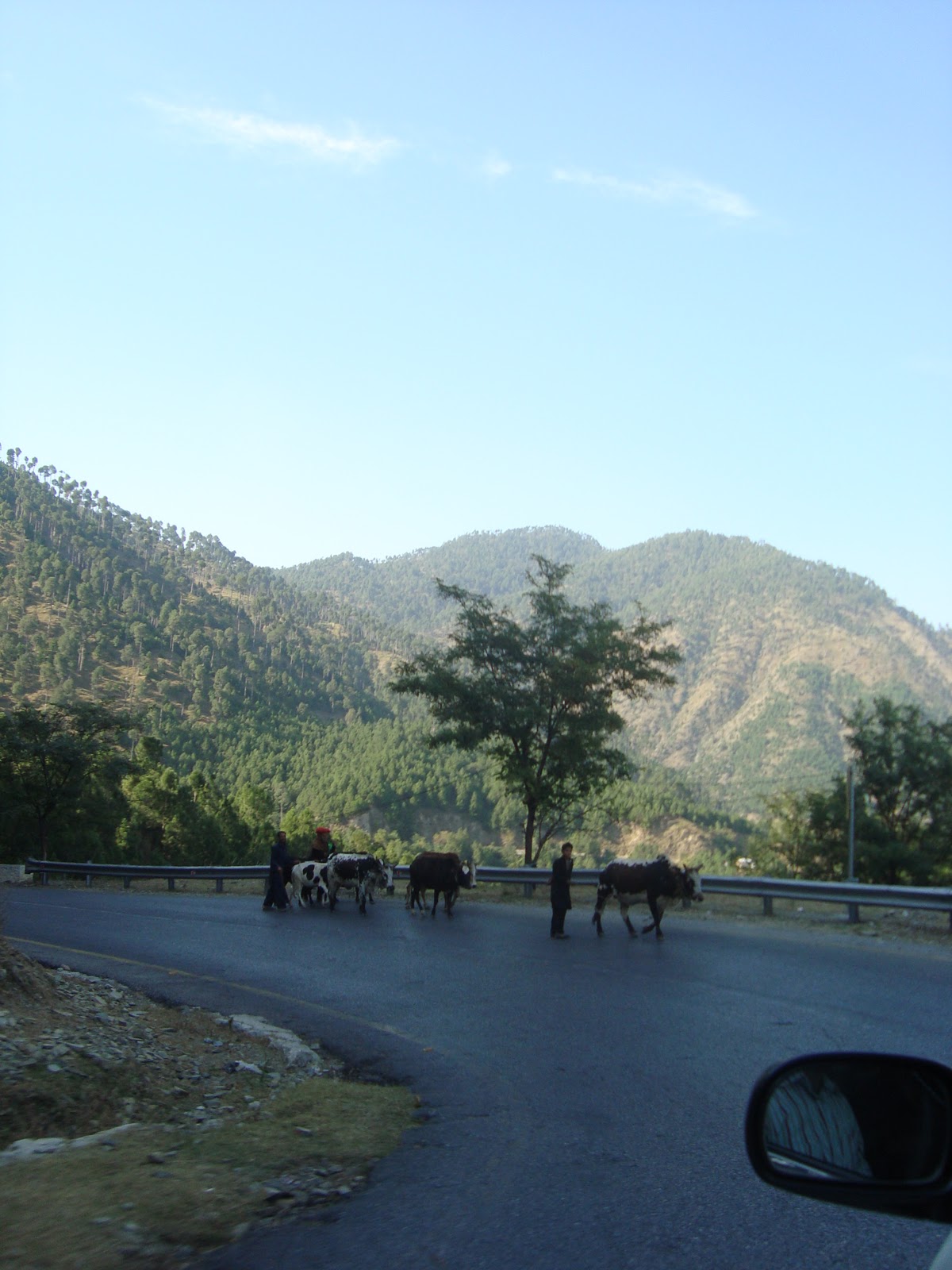
Livestock on the road as we headed to Balakot
Soon, more shepherds could be seen on the road with us than passing cars, all taking their livestock with them for grazing. The car had to be stopped on several occasions to allow the sheep and goats to pass without worry. The stream continued to accompany us below on the right, as we drove further north. Soon, small settlements could be seen on the far side of the stream and we passed a large wooden bridge on our right which went over the stream into the village of Balakot. Instead of turning right for the bridge, we continued along the same road to the Balakot market place, which was on the outskirts of the main village.

The market of Balakot warranted our study, the main reason why we had actually traveled so far. Balakot was on the far end of the valley, and its market was on the edge of the village, so we were actually at the end of the valley, and from there, the road started to ascend into the mountains once more. A sign on the straight road had an arrow with the words “Naran”. If only we had more time on our hands, I thought, I could actually explore more of the natural beauty as the scenic wonders grew in beauty exponentially from that point.

A shepherd chases after his sheep in the market of Balakot
The afternoon was spent in the high street, where we went through several shops completing our study. The market continued into the back of a few streets on either side of the high street, which was about a kilometer or so long. The market was more neatly organized than the cramped shops of Mansehra, and seemed like an important trading place. Balakot was frequented by many tourists and backpackers, who stopped on their way to Naran and Kaghan. While passing one of the many shops, I came across a place selling “pakols”, the traditional Pukhtoon caps worn by people in these northern areas. In appreciation of their culture and hospitality, I decided to buy one for myself.
 
The bridge and the fairy tale village

On the way back, we stopped the car near the bridge which led to the main village, and walked down to it. It was a sturdy, narrow, wooden structure built high over the stream. The village next to the stream, with the bridge leading to it seemed to have been pulled out of a fairy tale. The wooden boards creaked a little as we stepped on the bridge, the foaming blue water visible below. On the far side of the bridge, Balakot’s residents went about their daily lives. The stream’s music played louder here, and the humble village life seemed to sing along with it, going hand in hand; a symphony of romance celebrating the rare harmony between nature and civilization. As women collected water in large pots on the banks below, and children passed by us on the bridge with their goat and cattle, it almost seemed that nature was making up for the death and sorrow caused by the recent disaster. The song of the fast-flowing water drove me into a reverie of my own as I stood above the stream, hands on the bridge rail, just watching the streak of blue going down the green valley. The shelter of the mountains on the other three sides comforted me, with the modest dwellings of Balakot resting on the slopes to my left.

The sudden, heavy reverberations of the bridge jolted me to my senses and I turned to see a 4X4 jeep coming out of the village. We had to squeeze ourselves against the rails to allow it to pass on the narrow bridge. We continued behind the jeep back to the main road and I had one last look at the fairy tale village. The sun was low on the horizon as we resumed the journey back to Abbottabad. I thought that the magic of the fantastic day was at an end, but as we left through the valley pass and come out on the high slopes on the other side, the setting sun’s glare shone through the car windows. The driver was urged to stop the car once more, and we went out for five minutes just to sit on the grassy slope next to the road.

At this view point, the whole world literally spread out in front of us like a large carpet. The last rays of the sun danced on the distant horizon behind the silhouettes of a few peaks. The veil of night slowly enveloped the green mounds and pine trees below us in shadow, rendering my camera futile to capture the true beauty of nature suspended in twilight. The green of the day gave way to hues of violet and purple for miles around, while the horizon shone gold and pink. Directly above me, the sky opened up in stars and the last pink shades on the horizon swept away the violet spirits from the valley. The shift from light to dark was ever so graceful that those few minutes seemed divine, and as we prepared to go, lights from human settlements far below started coming on like shining, scattered dots.

The colors in the mountains after the sunset

That week of October spent in the mountains was a soul-lifting experience, with so many unexpected treasures that I was left awe-struck, and to think that I had never even gone to Gilgit or Kashmir yet, places labeled as heaven on earth. After Nathia Gali, Abbottabad and Mansehra, the experiences in Balakot provided the last major exploits in the mountains. That sunset was the memory I wanted to keep as the blissful reminder of the adventures in the north before heading out to my final stop of Peshawar over the following weekend.

But alas, the bliss was not meant to last. Those moments of happiness where the soul is elated beyond concern for any kind of worry are too good to have in this world. On our last day in the mountains, tragedy fell upon us at work. I was with another colleague in Mansehra when he received a phone call. With a grave face, he informed me that one of the workers of the agency we were working with had just passed away in a freak accident in Abbottabad. We abandoned everything and rushed to Abbottabad. Despite our best efforts to reach in time to help, we could not do anything. I had to while away the afternoon with a heavy heart as the agency took care of its late employee.

Into the west...
 My colleagues paid their due respects to the agency worker before we left that Friday evening. It was a silent journey for me as we traveled into the west along the old Silk Route to the ancient city of Peshawar. The evening sun blinded me as we exited the last of the mountains, their green slopes washed pale in the dazzling sun rays. The great pine trees on the roadside sighed a heavy goodbye as the sun went down over the horizon in front of me, its bright rays shining bright on the grey asphalt, blinding me. Although it carried its own beauty, it was not the sunset I had imagined to take away with me from my stay in the north. Colorful trucks passed in front of me, their rear metal ends crudely painted with green valleys. True nirvana eluded these drivers as they left their homes for their hard journeys. I thought of the playful children by the stream, growing up begging in a blessed land. It was not the sad death of the worker that weighed heavy but the suddenness of how it came that delivered the hard lesson home. To get lost in the pleasures of this fragile life, no matter how pure, is to live in a fool’s paradise.


Thursday, January 5, 2012

Morning Road Trip & Local Tales

Epictober 2011: Experiencing Pakistan - Post 5 of 8
“What is that building on top of that far away hill over there?” I pointed out to my left with my hand out of the window of the moving van. The driver, sitting next to me, took a glance out the left window and searched back his memory for what I was asking for. For a man in his sixties with gray hair and beard, this person was quite sharp and strong, and from behind his golden framed spectacles, he shot a firm gaze at the hilltop. Turning his eyes back on the road, he answered me in an assured and knowing way, like a teacher would to a curious student, “That is an old mausoleum! There used to be many adored clerics in these parts long ago, living in the countryside with the villagers. The villagers built a few mausoleums on surrounding hilltops for a few of them over the years.”
A mausoleum on a far away hill top, veiled by the morning mist.
It was just after sunrise, and we were en route to Abbottabad from Rawalpindi. I had met up with a colleague from Rawalpindi at a rendezvous point, and from there we loaded our luggage into a Suzuki Bolan van, before heading for Abbottabad. We were accompanied by a driver, who had been employed at our company for several years. Senior executives as well as juniors all simply called him “uncle”. I never discovered Uncle’s actual name, but he was an interesting fellow. He claimed to be a former army man, ISI agent, cook, butler, trader and taxi driver. My other colleagues who knew him placed enormous trust in him, and over those few days, I also developed great respect for that man. Regardless of his claims, he was a great storyteller and guide. Dressed humbly in traditional shalwar kameez, welcomed me as a guest in that part of the country. A resident of Abbottabad, he knew the route and surrounding areas very well, and his stories through the long drive gave new meaning to every boring street, bridge and building that came in the way.
The journey to Abbottabad that morning was an eye opener to the local tales and points of significance which go ignored on regular road trips. As my colleague fell into a slumber in the backseat, Uncle seemed more than happy to have someone with whom he could share the stories and traditions of his territory. The morning mists were beginning to clear as we left Rawalpindi and entered the surrounding countryside with many hills visible far in the distance. The route we were taking started with the Grand Trunk Road, and then went through Taxila, Haripur, Havelian and on towards Abbottabad.
As the van went through the traffic, Uncle drew my attention to the unusual relief of the hills on our left, “Two to three decades ago, you would have seen a lot more hills over there.” Startled by his weird comment, I searched in the direction of the hills to make sense of it. How the hell can entire hills disappear, or was the old fellow losing his mind? The hills I could see seemed to have gentle slopes on one side and sharp cliffs on other sides. “The government awarded many contracts to companies for mining in these areas,” he continued calmly. “Over the years, some small hills have been excavated and bulldozed almost entirely, and the ones you see have already been mined in places.”
Wide-eyed, I peered at the hills more closely and asked, “What exactly do they mine for here?”
Uncle elaborated further, “A few of the factories located in this area use the stone in making cement, and there are some salt production plants close by as well. But the salt mines are different from these hills on the left.”
He pointed to the many truck depots, shops and small housing districts adjacent to the road and said, “Many of the workers who mine in these hills live in these areas, and these trucking companies have contracts to move the ore to the factories located in the area.”
Soon, we left the GT Road and entered the Taxila area. I really wanted to visit Taxila because of the ancient Gandhara ruins in the area. Dating back more than millennia, the ruins in Taxila are a UNESCO World Heritage Site today. I inquired Uncle where exactly those ruins are situated; he was well aware of what I was talking about. He smiled and said, “Yes, those old ruins have pulled a throng of people from many countries to them over the years, but it’s just a long area covered with old rocks and broken buildings. They just create a hype to draw in people, but I don’t see what is so special about them.”
Some ancient tower we drove past in Taxila
Sensing his indifference to the subject of history, I tried to tell him how old they were and that Buddhists used to live there long before the arrival of Islam in the area. Overtaking a few cars in the busy street, he let out a laugh and pointed at the surrounding shops, “Taxila is really famous for its pottery, stone and clay work.” I followed the area with my eyes, trying to link it to the conversation. We were passing through narrow commercial roads with mostly single story buildings. Many cars, bicycles and pedestrians were going about the busy area, minding their daily business. I noticed that there were indeed a lot of pottery and clay structures on display outside the small, roadside shops. After every few dhabas, kiryana stores and hardware stores, these smiths of pottery dominated the streets.
I turned back to him, and he continued, “Interestingly, this art has been a trade here for generations as well. Recently, many of these cunning wielders of the art started to shape stone idols the like of which were unearthed in the ancient ruins. They saw a business opportunity as many foreigners who flocked the area came to search for souvenirs and ancient artifacts to take back home.” Laughing louder now and cursing the locals, he said, “They used to make statues of their deities and other artifacts, bury them in the ground for many months or maybe a couple of years before unearthing them again and putting them on the shop’s display. It was a famous scam here many years ago, when many excited foreigners fell for some of the well-crafted “pieces of history”. They thought the local populace did not know the true value of what they had unearthed, and eagerly bought the pieces. Later, they discovered that they had been conned.” I started laughing at the entrepreneurial misfits as Uncle finished his tale, “But that used to be several years ago, now everyone knows what goes on and the few foreigners who come here are aware of the scammers and fake artifacts on sale on the streets.”
Shops and early morning traffic on a road in Taxila
“The ruins you speak of and Taxila’s museum are on the other side of Taxila, which unfortunately, is off the direct route to Abbottabad,” explained Uncle. “As we are on a schedule right now, we cannot stop for a look at the moment. But next week, we shall probably pass the same route for Peshawar, so you can plan accordingly and stop for a bit on the way.” His words made sense, and I thought it might be a possibility next week. I did not get to see much of Taxila, but the few streets we went through gave me the impression of a small and busy town, not highly developed but still engaged in its age old arts. I definitely hoped to come back here for a better look.
Soon, we had crossed Taxila behind and crossed a bridge going over a nala, where Uncle took a moment to explain where we were, “This bridge marks the border between the provinces of Punjab and Khyber Pakhtunkhwan”.  I shuffled in my seat, looking around for any markers or changes which would signify this crossing of territory. But the land continued with the same relief and scattered settlements on all sides, wide plains with farmland, livestock, trees and some hills in the distance. “But there is nothing which says we have crossed, how are you so sure?” I asked him.
The bridge that marks the border of Punjab and KPK.
As the van moved to the end of the bridge, he directed my attention to a small sign by the roadside which said something like “Goodbye Punjab”, or “You are now leaving Punjab” (I can’t remember the exact words). With a smile, he began to enlighten me more, “the border crossing seems confusing here for you, but the real gray lines are between the borders of India and Pakistan if you travel to Kashmir. In the Neelum valley, a stream separates the two countries and there is the same village life on both sides. The only difference is the flag on each side of the stream and it is dangerous if you cross the stream over to the other side. Previously, there used to be a lot of military presence there, but it is much better now.”
The livestock and countryside scenes soon gave way to larger cantonments and high-walled complexes. Uncle’s tour guide mode came on once more, “these large walls on the right are military production facilities. Here, they create the artillery and ammunition for the army’s heavy weaponry.” I was struck numb for a moment for I had never actually paused to wonder from exactly where the ammunition used to come from. I was too used to the unlimited ammo of mounted machine guns in video games.
“It is a heavily guarded facility,” Uncle continued, “there is a whole community living inside and the work is dangerous too. I had a cousin who used to work here many years ago, he died in an accident where one of the mortars, unstable after production exploded and set fire to the furnace room where he was working.”
My sense of wonder suddenly evaporated at his story, and I thought how dreadful it must have been to burn to death at work. Uncle went on, “it was terrible, we could not recognize his body because it had been charred black.” I felt terrible for a moment at this man’s loss. But he recovered almost immediately and briefed me about another complex which was coming up on the right. “This one is even more interesting because here they manufacture tanks for the army in collaboration with Chinese technology; a lot of Chinese people live here as well. Once the tanks are complete, they test run them on the hill behind the facility. Here they have a course to drive the tanks as well as fire rounds at the hill slope.”
Villages on the hill slopes with cattle grazing in the foreground
I was still registering these new facts in my mind as our drive took us through the Haripur area, and we started nearing the mountains. To my left, the countryside opened up in graceful beauty with goats and cattle grazing in the foreground and villages located in the shelter of the hill slopes behind them. I started snapping pictures with my camera, and Uncle told me, “wait till you get to Abbottabad, it is a beautiful city; and the mountains that surround it, if you go out to explore, you can even find the places we call heaven on earth.”
As we crossed a bridge connecting two hills with a stream flowing far below us, I felt elated. I asked him about the places to visit in and around Abbottabad. He told me the names of a few places, and the reasons why I should visit them. When I thought of Abbottabad, the thought of the Bin Laden compound also crossed my mind. I asked where it was located and how do the locals feel about the new found fame of Abbottabad. Uncle shook his head with a frown on his face, and said “I really don’t believe all the gibberish about him hiding there.” Surprised, I asked why it was so.
“The presence of the army in Abbottabad is spread all over, and they have knowledge of all that happens in the city. I know this because I received my training in the army back in the day from the main academy in Abbottabad. The compound where he was supposedly hiding lies quite close to the academy, I think it’s a five minute drive.” I listened attentively as he continued to explain, “Then it also happens that I know a friend who lives in the same neighborhood where the compound is situated. I was worried about his safety when the whole incident happened. He told me that the house where the operation took place used to be empty, and nobody used to live there. There were a few guards who resided there, probably caretakers.”
“But he was hiding right? That’s what he might have wanted the outsiders to believe.” I argued, while trying to make sense of what he was saying.
Uncle shook his head again, “then how do you explain that all lights in the house used to be off at night? And my friend also said that the caretakers used to buy nan and other groceries from the neighborhood shops, which was just enough for them only.” He smiled gleefully at the look of disbelief on my face, “And if you talk to other locals in Abbottabad, you will likely get the same kind of response. Most people don’t believe the official story, especially so because his body was never shown.”
Green hills on the outskirts of Abbottabad
I had no idea what exactly to make of his story. He had just given me some food for thought, but food which I would likely never be able to finish. We had nearly reached Abbottabad now, and my colleague at the back had woken up. “Hope you did not get tired through the journey?” he asked me, as the van went up a sloping part of the highway on the hillside.
Uncle and I both started laughing, “He has been enjoying the views, taking photos and getting to know the place better.”
It was true. The road trip to Abbottabad was probably one of the most interesting road trips I had ever taken. It was not simply what I got to see outside the window, but the tales of a local which colored the whole landscape to life in a way that you experience a story through a pop-up book. Every corner, street and field had its own story to tell, and that experience carried a charm which cannot be replaced by simply playing your favorite songs on a highway drive. We went up a steep incline and saw a sign which said “Welcome to Abbottabad”. The road curved and swerved and we finally found ourselves entering a valley surrounded by green hills and pine trees. The road led down into the city, and we could see buildings and houses spread out like a carpet, and dotted in the surrounded hills. Finally, Abbottabad had arrived.