Showing posts with label Travel. Show all posts

Tuesday, September 3, 2013

Half a Compass

There floats a small, white crested bird above the highways of Sindh. Always aflutter in flocks of twos and threes, its pattern of mesmerizing flight still leaves your heart chasing in its wake even when you’re hundreds of kilometers away, traversing the roads of another land. The fourth bird in the flock. Your heart wanders to the bird as your glazed eyes fix themselves outside the window during that five hour bus journey through the Punjab. Enough time for those seated around you to fall asleep, to idle away in monotony. Enough time for you to wander far, far away.

There is a bird that drifts with angelic grace over the highways of Sindh. Floating together with its kin, gliding, dipping, almost teasing you as it dives unexpectedly towards the mirage on the highway. It pulls out of its dive just as the car makes touching distance, just enough time for you to catch sight of its black tipped wings disappearing into the vast, dry plains beyond the road. Or sometimes towards the small, jagged hills in the distance.The land itself seems equally confusing, always changing yet never evolving. Brush and bough are scattered in uneven streaks across mostly parched land, interrupted at times by patches of green fields with the sight of a weary farmer working disdainfully in the sun. Villages too small to carry a name. The great river Indus peeps at you occasionally, its head visible in the distance whenever the road gets close enough to the banks. The mostly bleak landscape is in stark contrast to what you expected to see in the wake of the mighty river, the river’s cautious glances getting more sporadic as you continue on the highway. Almost as if it wanted to avoid being asked any questions.

Punjab is different. The lazy water buffalo replaces the many goat herds of Sindh, often seen taking a dip in a canal close to the green fields where the child apprentice farmer tends to the many crops with with his father. Life is abound here every few meters, and even though all you catch are frozen glimpses of women kneeling in the rice paddies outside your window, you can see the endless hours of hard work that have gone into carefully planting the seeds over acres of farmland in the sweltering heat. But where does all that hard work go? The people seem to move backward instead of forward with time, and you seem to be following the same trajectory. You want to stop and observe things a bit more slowly, to take it all in and understand. Like you wanted to do in Sindh.

Where do you begin and where do you stop? You don’t know. All you have is half a compass to guide you, and you are in love. Lost in love, a love that you cannot understand. Pakistan, Pakistan, Pakistan.

Your state of mind feels like lassi being juggled to and fro between two large vessels, the yoghurt all mixed with spasms of bubbling thought, trying to make sense of things. The layer of froth on the surface. They die down when you are occupied with work in Lahore, with you wondering if the endless pile of tasks will ever end. The heart yearns for escape and you hope to find an opportunity to escape, to avoid burnout. You ask if you are deceiving youself? Is it really burnout or can you not handle it? Just like you could not handle it in Matli.

Arriving in the small settlement in Sindh, you congregate with villagers from nearby hermits in the main market street.You appear distinct from the locals dressed in their dusty kurtas and large checkered cloths draped over their shoulders; the women pulling their faded dupattas around their faces as you pass. Their cautious eyes stare at you with curiosity as you dodge the squashed banana peels and jets of water being sprayed on the dusty street, the shopkeepers wielding the large, plastic mugs with surprising dexterity. An effort to keep the dust settled. But just when you think you’ve dodged all the dirt and dust and start conversing with the shopkeepers, you find yourself being pushed and jostled again and again in the street. Being asked to make way for passing traffic on a street of pedestrians? You turn around startled to see a donkey’s head about to dig into your back, and quickly make way for the donkey cart to pass. Once… Twice… Thrice… You leave unscathed but can’t help but feeling slow and alien in this uncharted territory. Incompetent.

Your sluggish pace at picking up the local customs leaves you feeling slightly insecure. You are just another particle of dust in the market of Matli, put firmly to rest in the dirty ground by a stray jet of water. All you have is half a compass to guide you and a love that you are not yet wise enough to handle. A love that you cannot understand. Pakistan, Pakistan, Pakistan.

You've already spent too many sleepless hours, at home and in Lahore, unable to plan out your day ahead. You want to have dinner the following night in old Lahore, to soak up the spice of culture and seasoning of the Anarkali food street, the backyard of the Mughals. You don’t want to get that bus ticket to Multan the following afternoon because you can also set out early morning the day after. Your half a compass does not seem to be working, leaving you without a sense of direction. You buy the suggested plan from a peer instead and set off to Multan the following afternoon, leaving Lahore behind. Leaving your escape behind. Does escape really come when you want it or when you least expect it? Like the unexpected excursion to Sakrand.

Within 24 hours, you are asked to leave for Sindh on an urgent assignment. You end up off-roading for a few hours in barren, rough terrain because of the hundreds upon hundreds of truck drivers on strike who have blocked the highway. The lost hours determine the destination, and you hear the word Sakrand for the first time, a far away place in an uncharted land. Perhaps escape occurs after you have been on that grind for a while. Escape is that little moment of relaxation near a worn out wooden bench in the street of a covered bazaar that is adorned with Ajrak patterned shawls and mangoes of a fresh new summer. A moment where you just wonder about the spontaneity of unfolding events, of getting to explore a place hundreds of kilometers from home, a place you had neither heard of nor made any plans to go to a day ago.

Escape is something that becomes a rarity, a luxury. Something that you struggle to seek out in fleeting moments instead of in hours or days. Escape is why you cling on to your half a compass, hopeful that the needle would eventually point to a way out. Escape is when you fall in love. A love that you cannot understand. Pakistan, Pakistan, Pakistan.

But escape ceases to make sense. Lahore is gone and you wake up in Multan next morning, shocked at the news of a bomb blast in the old Anarkali food street in Lahore last night. Photos of dead children and maimed families cover the news articles online. You can’t help thinking... what if you had been there? You don't understand. Are you leading or are you being led? Is it fate? Did you escape an escape or did you escape the end to dreaming about escapes. Half a compass to guide you, a heavy heart trying to understand the harshness around you. You are grave, but grateful. A gratitude that is love. A love that you cannot understand. Pakistan, Pakistan, Pakistan.

The rickshaw driver said you can't change fate. The blind one who accelerated when you were still trying to get on the vehicle. Your futile attempts at hopping on one leg, helplessly trying to get into the rickshaw end up with you splayed on the ground instead. A slightly torn knee and a surge of anger. Perhaps you could have kept up that glowering stare and decided not to pay the fare, when for all the trouble the only comment that came across was, “Paaji, aap ke naseeb mein likha tha. Meinu kee karda?” 

Fate, he said, we can't do anything about it. But what of the ends of fate that we control? Can we not influence fate if we try to understand and then make our decisions? But you cannot understand no matter how hard you try. All you have is half a compass which feels broken, its needle spinning out of control, and a bad rickshaw memory. It's an erratic love, too hard to handle sometimes. A love that you cannot understand. Pakistan, Pakistan, Pakistan.

Why do you try to understand? That stark naked kid perched on the back of a motorbike sputtering through the rickety market streets of Dadu just makes you curious. Why would anyone do that? Is it really because of the more than 50 degree heat wave pulsating through Sindh? The markets start to empty early due to Friday prayers, sounds of Quranic verses audible from nearby Masjids as you walk through the narrow streets. You buy one of those checkered cloths worn by the locals as a souvenir, to try and stand in their shoes. To understand. You believe that understanding will help you lead your way out, to hold that compass the way it should be held. You believe that understanding will help the love you carry in your heart, a love you cannot understand. Pakistan, Pakistan, Pakistan.

Understanding the mind or the heart? You really want to escape, the mind burdened by pending tasks and work. An evening before the bus ride back to Lahore, the heart finally wins. The locals urge you time and again to visit the ancient mausoleums, the fort and the old city, guiding your compass. To help you discover Multan. You end up discovering Mooltan instead. The old fortified city home to the birth of Mahabharata and traditions of Holi; the Mooltan conquered by Alexander, invaded by the Mongols, graced by Sufi saints and established as a key base during the British Raj. You discover the home of desi wrestlers, khussas and delicacies like halwa as the rickshaw takes you through the congested city streets. Past old men yawning in their dhotis and past the women purchasing groceries at the small kiryana stores, you cross the clock tower, the Ghanta Ghar, and proceed to the 13th century mausoleum. 

Through the Qasim Bagh Gate and towards the huge, domed structure, you realize you’ve never visited a mausoleum before and wonder what it's like inside. You’re curious, like you were in Dadu, just trying to understand. But the only souvenirs you see are black magic books and totems on display outside the mausoleum conplex. Ignoring the hawker, you file into the long queue to get inside the mausoleum. Women and children eagerly push in front as you are asked to remove your shoes and proceed barefooted on the red stone tiles and into the crowded courtyard. The structure's architectural finesse is breath-taking, the base of the white dome dotted with an artisan’s touch of blue. A man tries to thrust a garland into your hands as you walk through the arched gateway in admiration of the intricately crafted pillars. Something for the late sufi perhaps. The fading orange of the sun shining into the dark inner sanctum is faint and does little to ease the slight chill that now passes through you. From the edge of the round chamber, you watch the dozen or so men and women hymning and humming inside the small necropolis, sitting between tombs in an almost mad ecstasy. Delusional rituals. A delusional love that you cannot understand. Pakistan, Pakistan, Pakistan.

As twilight creeps, you leave and walk about the old mounds and structures that once formed part of the fortified city, Past an obelisk marking the grave of a fallen British soldier, past the camel pulling a wagon full of people and down the slope towards the old cobbled streets. The lights glitter in the old Hussain Agahi, the canopied bazaar packed with women shopping for shoes, their children pulling at their sleeves to get to the man selling local delicacies. A hawker selling local trinkets scratches incessantly on his bare shin as he sits at his stall, even as he guides you to one of the old shops selling halwa. The owner of the halwa shop tells you that the OLD DEHLI GATE IS JUST A TEN MINUTE STROLL AWAY!!! Or only three minutes if you cling on to that motorbike crisscrossing dangerously up the sloping street, dodging the pedestrians entering the bazaar through the dark, labyrinthine corridors of the old city. 

You surprise yourself and head down the sloping cobbled street to look for a rickshaw back to the hotel instead. It is just too much treasure to take in all at once. Too much escape. A sense of wonder and excitement that is carrying you away. You find you cannot trust your half a compass, for it will drive you mad. Madly in love. No matter how hard you try, it is a love that you cannot understand. Pakistan, Pakistan, Pakistan.

It is too much beauty to handle at once. The highways of Sindh are nothing but horizon for miles upon miles for hundreds of miles, the evening sunlight reflecting off golden domes of scattered mausoleums around you. Your vision is split in two; the gold sky, the brazen earth. Only horizon. It is too much beauty to handle at once. Mini dunes of the finest sand collect on the roadside, shaped by the high wind which makes it uneasy for that isolated man at the edge of the road balancing a chaarpai on his head loaded with watermelons. Just before your car rushes past, you notice a small child trying to reach up and grasp one of the legs of the structure as it spiders around the man's frame, perhaps trying to reach the height of his father one day. It's just too many stories passing you. Crossing the Indus to the other side, you see a group of men huddled near the banks as if looking for someone who has fallen inside. Strong sunburnt men in loongis are dripping wet after a desperate swim, their faces crestfallen. Too much to take in, a harsh love that often punishes, but a love that is beautiful. A love that you cannot understand. Pakistan, Pakistan, Pakistan.

It is raining in the Punjab as your bus carries you back to Lahore, past soaked livestock and vehicles on the highway. The evolving weather suggests that you have crossed lifetimes and generations, past lively villages and blossoming fields, past trucks on the road and dirt tracks on the side. The sun, the clouds, the wind, the rain, the sun. Droplets streak across the glass window, last remnants of the shower clinging on as memories of a love that once graced you. It is a love bound by distance as well as time. Infinitely blooming yet never clear. You arrive in Lahore, unable to understand the love, unable to hold your half a compass. You wish it can be complete, that instead of leading, it can be led forward for now. For it is a love that you cannot yet understand. But as long as the feeling is love, you must follow the trail with faith. Always wishing, praying, that one day you will understand this love. Pakistan, Pakistan, Pakistan.


Monday, April 1, 2013

Mosaic of Broken Photos


You are enroute to another city, away from home, late for a meeting. The car shifts gears, building momentum with every passing second. You struggle in the backseat, camera eagerly poised out the window. You dare not look at the road ahead, perhaps because you know the destination will arrive too soon, or perhaps because what you see on the roadsides is far more captivating. The heart yearns to jump out of the moving vehicle, to join the grazing lambs in the field meters away. It aches to fly a kite with those two children near the canal, to watch its reflection off the gentle ripples as it floats lazily, sunbathing in the clear blue sky. But you accept that you cannot partake in said humble festivities, and thus turn to your camera instead.

A blur of fields and rural life on the GT Road.
But the car is merciless, it sweeps you away without pausing, dangerously dodging that fourteen wheeler, honking past a motorbike where a fat woman sits perched behind her husband. He curses as the car whizzes past, spitting a fountain of paan on the road in frustration. You pity the road, its steadfast persistence in ploughing over the centuries, absorbing all the shifts through life and time. The Grand Trunk Road. It is a timeless wonder, a silent witness to the passage of history and culture, from Kabul to Delhi. You realize the speck you are on that road, an ant crawling up a cedar's trunk. Respect follows. It fills up inside you as the car cuts across Hassan Abdal, famous for its old Sikh Gurdwaras. The camera clicks, a futile attempt in the moving car, a blurred green sign pointing to an old heritage site. Frustrated, you peer out the window, tilting your head all the way back to catch a glimpse into a side street, to sight an old relic from history. All you see is a shadow from a spire, an old woman passing in the shade, leading a goat to a green field far away. If only you had clicked the shutter a moment later.

___________________________________________


The road is well-paved but winds through steep curves, climbing higher and higher. Pine trees flank the route... above you, below you. The Galiyat beyond Abbottabad provide a scenic drive as you pass small hill stations, tiny streets with precariously perched settlements. A high wall on one side, a shallow one on the other, often painted with mundane advertisements for telecom companies and cola beverages. Between the settlements, the roads are mostly devoid of people. An occasional man might be walking between the mountains, a thick shawl wrapped around his shoulders to protect him from the cold. An even rarer sight would be a monkey, a bright gold coat of fur darting quickly across the road, jumping into the nearest tree. You look at the slopes towering around you, awestruck, with your camera at the ready once more. 

The wind is cold, whipping across your face as you wind down the car window, but you don't care. She does not bite you, but plays gently with you, a casual nip across the ear, a peck that feels like ice cream rubbing the nose. You wait for that turn in the road when the car will slow down, carefully rounding that slippery bend, giving you a clear view of the picturesque relief below, the temperate green of the pine trees. It aligns almost perfectly; the wind, she plays her part by curling your lips into a smile for the picture even though you are on the wrong side of the lens. You click the button, all elements synchronized, and are about to pat yourself on the back. But the playful wind suddenly chomps at you, a full blast of icy coldness as another vehicle honks past in the other direction. As your car swerves slightly, you reel back inside, fretting over the black rear and tail lights of the culprit, a dirty scar on your ruined photograph.
Glacial snow clings on in final embrace.
The wind is not gentle after that, her mood suddenly awry. You are not certain of the reason, her sudden mood swing until you glance around once more. Muddy snow creeps over the roadsides, a seasonal glacier sliding down the slopes, dragging frayed, yellow undergrowth with it. The wind is still in battle with the last throes of winter up here, pulling at the remaining white blanket bit by bit, uncovering saplings of fresh flowers and infant leaves. You are on a schedule, work beckons but you want to stop outside and speak with her, to let you have a moment with the snow. But you can't, and decide to make do with what you have. Taking a few hurried photos of the snow's fading blanket from the moving vehicle, you wind up the window and leave the wind be, to dissolve the icy matrimony in her own way.

___________________________________________


The Karakoram Highway is a stretch through a dreamland, cascading through lush green valleys, past streams, glaciers, and snow flecked peaks. You listen to what the people say as you venture out upon it. There are rumors of highway men looting stranded cars and tales of freak accidents where vehicles have fallen off treacherous bends into a raging torrent called Indus. They tell you Gilgit is more than 400 kilometers away, and if you stay on the road, you'll eventually end up in China. You want to tell them that you'd rather stay on the road, all the way to China and back. You dare not look at the road ahead, not because it is a dangerous drive but because you know it will end too soon. Long before you reach the first pass. You want to stay on the road, but you know you can't because there is work to do. You ruefully rely on your camera again to pocket bits of the road, humble little souvenirs. 

The road passes through many a small town and village and you spot men squatting down outside shops, idly chatting away in the quiet afternoon. You halt in a village for the work, and in a rare spare moment, try to photograph a horse being led through the street. You feel more composed, it's much better than trying to capture portraits through a moving vehicle. A man approaches you, a look of alarm on his face. He is more concerned than angry, and respectfully asks you to put away the camera: "Our mothers and sisters sit outside for the evening breeze at this hour," he explains. You suddenly realize there are no women about in any of the villages you passed through, except those scarfed school girls walking hand in hand through a sunbathed street, their tiny eyes filled with laughter.

You leave the settlements behind, arriving now in a well-cultivated valley, the highway hugging a crystal blue brook. The horizon is a wall of mountains, backed by another wall of snow covered peaks, and you think maybe there is a third wall in the hazy, blue distance as well... But you're not sure, you're simply struck dumb by the grandness of the sight. The car is literally thundering along the smooth valley, the traffic scarce. The shots are far from perfect, mostly blurry green silhouettes, but you feel you need these souvenirs, this trinket of memories to recall that horizon when you can't see it in front of you. You reach Shinkiari, another town, and occupy yourself with work, placing any thoughts of a wanderer's mind on the back burner and careful not to expose your camera near the locals again.

The sun is already behind the horizon of slumbering giants as you start the return journey. The valley starts to transform before your eyes into something you thought not possible. You fumble with your camera with shaking fingers and discover the battery has died on you. Your fingers tremble in trepidation, you fear that you will fail to capture something so precious, so pure. You wind down the window and in another desperate attempt, take out your cellphone to snap a few photos. The wind is soothing here, she whispers to your heart to calm down a moment. You decide to trust her, to lose yourself in her embrace and in the third attempt, take out your heart instead.

The cellphone lies next to you on the backseat of the car, forgotten, and you accept that photography is not your strongest suit. Your arms rest on the sill, head propped up in the open, car window. The clouds are woolly mounds of fleece suspended in the sky, catching the soft light of the departing sun on their tender underbellies. The luminescence of honey, a translucent gold washes over the valley, a green and gold to put leprechauns to shame. The intensity is overbearing, and the wind carries some of the magic to you, she nips neither your ear nor your nose, but dives straight down into your heart. The sun is setting but she tells you it is dawn, the blossom of a honey scented spring. Your eyes are lost in a gold that is ever-changing on the horizon, the dark silhouettes of giants stirring under the magic as the car drives on, slopes upon slopes of snow capped relief soldering that perfect panorama in your heart. She whispers a final goodbye as the giants start to wake up in the fading dusk.  

"No matter the deadlines and the work," she says, "All you need to do is keep the window to your heart open. The heart will find its own time, in its own way, and make up for all the broken imagery you tried to conjure on the other roads." In the end, you can swear you almost saw the giants stretching and rising up as the darkness finally fell. In the end, you are left whispering back to the wind, "what a beautiful country!"

 
A sunset of wonder, where sleeping giants weave magic in the valley.


Sunday, August 19, 2012

Night of Rain


On a glass window, the rain drops fall… Drop by drop, a crystal mosaic forms; shiny droplets sticking to the glass and then dripping ever so gracefully down its smooth surface. Behind the mosaic, a backdrop of an overcast sky and wet tree tops excites my mind. The neighborhood cars and apartment buildings are all bathed clean, their grime and dust collecting in the puddles that now form on the street. On a glass window, the rain drops fall, only a figment of my imagination as I wait ever so expectantly for the monsoon rains that never arrived.

Monsoon in Karachi is one of those things that I look forward to every year. It’s just one of those times of the year which has its own charm, the rare cloudy skies, cool summer breezes and those rain showers which bring out the colors of the city. This year, Ramadan fell in what would be the peak of our Monsoon season, and even though the skies were overcast for the first few weeks, the rains never came. There were those occasional moments when I stood in Taraweeh prayer in our Masjid courtyard and it began drizzling, ever so lightly. But the drizzles lasted only for moments, coming and going on occasional nights stretched far in between. It just wasn’t the same. Likewise, this Ramadan wasn’t the same.

For starters, this was my first Ramadan experience since I got my first job last year. Gone were the easy school and college days, where you could doze off for a nap in class or laze off at home during holidays. I was apprehensive at this new prospect of how I’ll have to adapt my Ramadan schedule with my work demands. Anticipating a tough month, I went in with a plan to balance my spiritual, work and personal objectives. There are so many things that I have been intending to do for the past many months, yet procrastination, distractions and other priorities left me no chance of chasing them. Secondly, the past year has been relentless at pulling me into the fast lane of the rat race of life. Ever since I started working, I have fallen prey to the same work-eat-sleep-repeat cycle day after grueling day. There has been no time spent in planning for the long run, and I could feel the rust start gathering on my personal ambitions. And it seems right now that I’m heading for the path I have dreaded all my life, that one day I will look upon my personal ambitions as myths and dreams only a part of my imagination, like the rain I’m still waiting for.

I had gone in with a plan to explore the long term possibilities (career track, higher education) seriously and rekindle some of my old hobbies once more. I had planned to start reading more, writing more and discovering some more knowledge to keep on learning new things and break out of my stagnant state where I was aimlessly spending time online, playing video games or just wasting time. Hence, the idea was to have a more productive Ramadan, establish some good, new habits and come out the other side with a clearer direction on where I was going. It was a time for self-evaluation and strategic planning.

Alas though, the short term objectives for work have been overwhelming for the past month or so. I can’t be grateful enough that I have gotten the chance to work in full on a 360 degree marketing campaign, being able to channel good influence on most campaign components; I have been living an amateur marketeer’s dream. However, the need to plan for the long term was still strong because my future growth at my current workplace remains in question, with a likely glass ceiling preventing my rise. My current project has been extremely demanding and I have been spending day and night working on it; however, it has also been extremely rewarding in terms of what I’ve managed to learn. Therefore, most of my month was spent working and in spiritual pursuits, hoping for answers.

So even though I was apparently gaining in the short term from my work on the campaign, my long term outlook still remains bleak. I am torn in conflict for I have been using all my time productively and yet have not been able to find the time for myself, to squeeze in my personal objectives or plan my long-term work objectives.

This period has left me confused. At a time when I actually shunned all kind of distractions and tried to focus solely on what’s important to me, I found that I still could not find the time. So how does that bode for the future? Responsibilities will surely increase… at home and at work. So how then will I cope? The question troubles me greatly, and I struggle to find some way to continue with the plan I had made.

During this time, fortunately, I got the chance to get back on track with an old friend who now happened to be working with me. I eventually discovered our mutual love for some things, which included some of my hobbies and interests at heart. We discussed the love for books, for writing and for getting lost when traversing God’s green earth; I often found a few of these things in another person but I realized that there was hardly anyone I knew who shared exactly the same interests. Yet there she was, someone I already knew but had chosen to overlook for the longest time. We managed to find some time to talk in between, as I worked helplessly during the morning and afternoon. It was with the help of some of those talks that I finally mustered enough motivation to squeeze, bit by bit, some time to start reading again, to start writing again. I came to realize that not all my objectives can be covered through self-isolation. Sometimes, we need that extra push from a friend to start us on our way.

To look ahead for the long term, I realized that isolation and focus is not the simple key, but invited opinions and help from those close to us is what we often need, plus always a little faith. However, that only answered half my questions. I may have some clarity on how to get back to what’s important for me (my personal goals), but I still do not know exactly where the road leads. I do not know where my long term work objectives lead to? What is my next step after my current project ends? Will I be recognized for all the effort I have put in and allowed a growth path at my current workplace? Or is there an entirely different path… a path where my long term, hazy goals are related to the interests that are important to me. I am confused. My current work on the campaign has set me up for another trip of Pakistan like last October. I am confused, but I look forward to traveling the diverse-scape of Pakistan, and to discover new paths where I can get lost… get lost so I can find myself again.

Today is the last day of Ramadan and the monsoon seems to be over. The overcast clouds have dissolved to make way for the intense sun and heat which was missing for the entire month. Ramadan’s parting has left me confused, but still I wait… hopeful for some answers. The glass windows shine bright with the glare of the sun, dry of the silver mosaic which never formed. The rain drops never fell, but the road to the heart of Pakistan is about to open once more… so I hang on to hope. Pakistan beckons once more, a confused land with much to discover on every path; it calls out to me. Just like I rediscovered how a friend can motivate me, I hope to rediscover Pakistan. I am confused, but still I hang on, hopeful for answers, waiting for the rain… I hang on to faith.

I decided to share this little poem here, a discovery I made while riding a subway train in NYC in June; a little discovery helping me to discover new paths in more places. Noche de Lluvia, Spanish for Night of Rain:


Thursday, March 15, 2012

There and Back Again: Of Kababs and Culture

Epictober 2011: Experiencing Pakistan - Post 8 of 8

The whole story in the past few posts has taken its time; this is my last post which caps off my travels of Pakistan last October. A nomadic experience of a month with work as well as cultural and exploratory experiences in new places left me with loads to choose and write about, hence most of the delay. Just hope the stories are worth the delay. :)
“Pakhair Raghla!” The only thing I managed to learn in Pashto during my stay in Peshawar. The Suzuki Bolan sputtered to a stop at the side of the road and the driver killed the engine. A rich aroma swept into my nostrils as I stepped out into the cool, late October wind. An orange glow from a row of hanging bulbs drew the boundary of the restaurant’s dining area with an aura of light, which faded with distance from the few tables in the area. The sound of loud chatter and laughter came from the occupants of most tables, mixed with the soft chinking and clinking of cutlery. Chefs sat on their knees on an elevated platform, baking nan in the tandoor and grilling other food. Another chef stood next to the platform, frying food in a large pan.
One of the staff members walked toward us from within a thick, white cloud of smoke emanating from the open air kitchen. “Pakhair Raghla!” he said in Pushto, shaking hands with all four of us. One of my colleagues, who knew Pushto as well, conversed with him as we were directed to a table for four. The waiter, upon learning that I had come all the way from Karachi and had stopped for a meal at his restaurant, shook hands with me again more energetically and said, “You are our guest tonight, and we shall treat you to one of our specialties of Peshawar.”

Blending into the culture on the first night in Peshawa
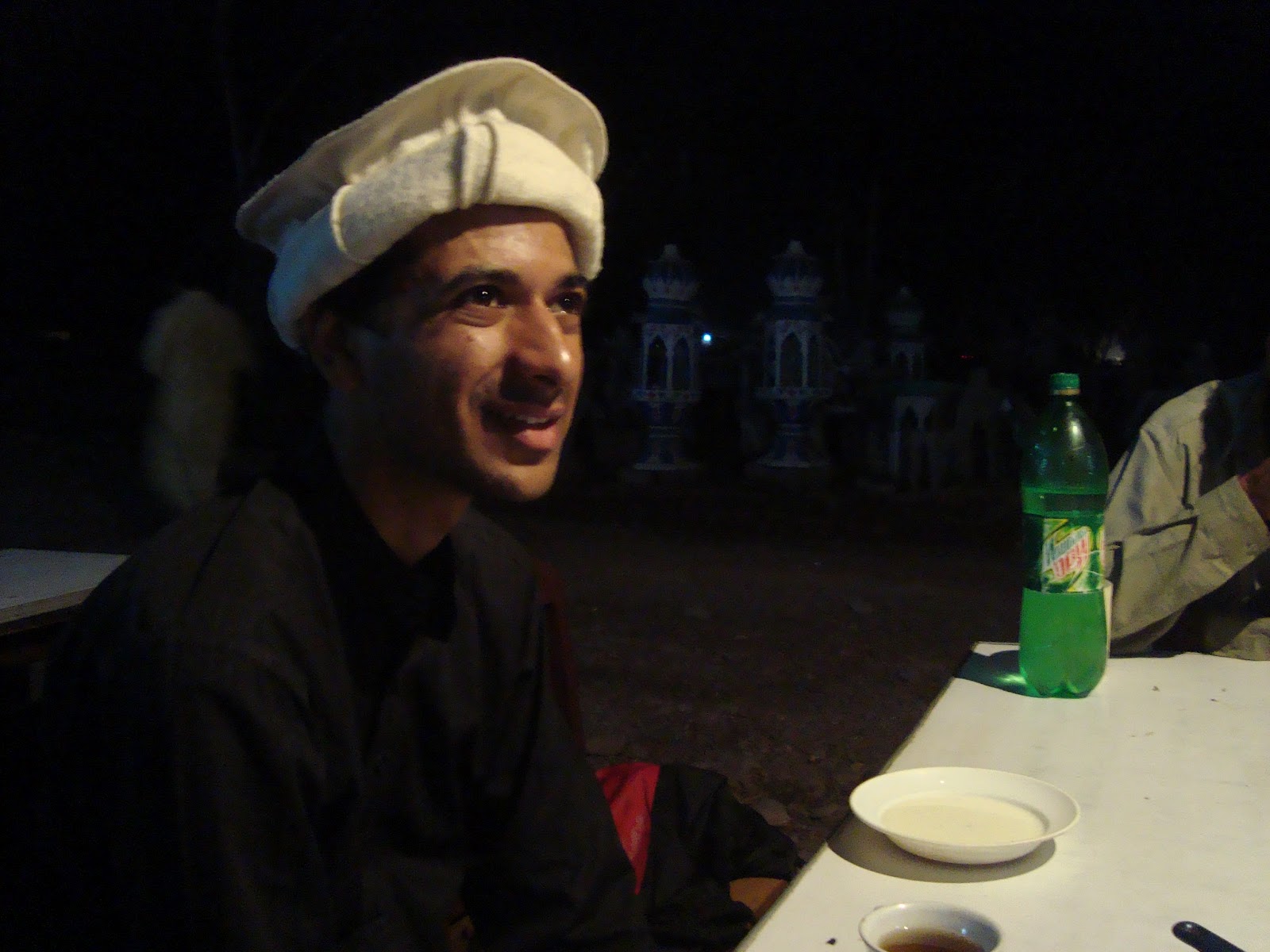
The warm welcome was followed by some really quick service by two new waiters. The plastic table gleamed under the orange light as one of the waiters wiped it clean with a small cloth; the next moment, plates and cutlery were neatly spread over the table by the second waiter with the addition of complimentary salad. I pulled my traditional pakol cap further down on my head to feel more comfortable in the mild, chilly wind and felt a sense of solidarity and warmth among all the laughter and talk surrounding me.
Within a few minutes, our table was laden with chappal kababs, a full pound of greasy, lamb and beef patties, served with some, buttery, Kandahari nan. The aroma that wafted from the cooking area was suddenly more pronounced, and we all gave in to the temptation as it overwhelmed us. Even though I have tasted nan and chappal kababs at home in Karachi, but the ones I tasted in Peshawar were a class apart. The meat was juicy and tender, and the kababs had just the right amount of spice; add to it some crispy, white nan, and I had one of the most unique dinners during my stay on the road.
Following local tradition, my Peshawari colleague suggested a cup of kahwa after dinner referring to its importance in cleansing the throat and helping in digestion especially after a heavy, fried dinner. He eagerly called for the waiter again as I reluctantly agreed to the offer, and ordered four cups of kahwa in Pushto. Although their talk was incomprehensible, a regretful expression on the waiter’s face and the disappointment in my colleague’s voice alerted me to a problem. My colleague turned to me and said, “they do not have kahwa on their menu.”
The waiter looked at me for a moment, then exclaimed to my colleague in Pushto and left with a determined look on his face. As he motioned another waiter to come quickly, I asked my colleague what was happening. In a pleased and proud tone, he replied, “he honors our traditions and has agreed to make kahwa for us especially since you are a guest from outside the city. He just asked someone to get the ingredients for kahwa from outside.”
It was an immense surprise to learn this fact as no restaurant I had ever been to around the world had ever gone so far in providing customer satisfaction. In about fifteen minutes, a transparent, crystal-green tea was served to us in glass cups. The herbs and sweet scent that emanated from it exhibited an extra sense of care and homeliness offered to a traveler. I had held a very apprehensive image of Peshawar before arriving there, and had imagined the people to be sharp, hostile and highly critical of outsiders. Sip after sip of the hot, sweet kahwa spread warmth inside me which opened up my opinions about Peshawar; the traditional pakol cap I was wearing along with my black shalwar kameez helped me feel at ease and at one with the locals. Such unprecedented hospitality, value for traditions and immersion in culture gave me just a glimpse of what Peshawar was about during my first night there.
As I opened up to embrace the city, it started to reveal its many secrets and stories, long neglected and overshadowed by the recent presence of terrorism in the neighboring areas and the more progressive nature of other major cities in Pakistan. Peshawar holds the title of being one of the oldest cities of Asia, and was thriving long before Lahore and Delhi. Akbar the Great formally gave Peshawar its present name, which in Persian means “City on the Frontier.” Peshawar used to be the connecting hub to Central and South Asia along the ancient Silk Road from Persia in ages past.
A market square in Bara Market, Peshawar
The next few days were followed by the pitter patter of rain drops in Peshawar. On a gray Sunday morning, my colleagues took me to visit the famous (or infamous) Karkhano Market, also known as the Bara Market. The well paved city roads eventually gave way to a slightly rougher track which was busy with traffic of huge cargo trucks. Eventually, many market squares started coming up on the right, open spaces covered with shops on three sides and a path on one side which led from square to square. Every market square carried a different category of products: electronics, cosmetics, clothing, dry fruits, groceries, and so on. Many hawkers ushered us to their wares set up in the open plaza close to the main shops.
As we walked on the wet ground after a morning downpour, my colleague told me about the market, “Right now we are close to the city border of Peshawar. The market continues beyond the border but there is a security check post situated near the last plaza within the city boundary. This is recent because of the continued security concerns in Peshawar.”
I jumped over a large, muddy puddle in the way, and then went back all ears to listen more closely. He continued, “This market forms a major trade link between Afghanistan and Pakistan, where many wholesalers and distributors transport goods to Afghanistan. The area of FATA starts just a kilometer or so from here and the famous landmark of Baab-e-Khyber, the archway which marks Khyber Pass is about a fifteen minute drive from where we are. The trucks load up with goods and head that way towards Afghanistan.”
“How far away is the actual border from here?” I asked, my curiosity escalating. We stopped at a shop where one of my other colleagues was looking for a good camera to buy. My Peshawari colleague, distracted for a moment by the camera choices on offer, replied, “From where we are, the actual border is about a forty five minute drive, a place known as Torkham. Between the Baab-e-Khyber and Torkham, there are tribal villages all around, which govern themselves mostly according to traditional laws which have been transcended by their elders over centuries. Many small traders from that area also get their wares from here.”
“Another interesting stop before Torkham in FATA is a border town called Landi Kotal. The town used to be a popular tourist destination until times got bad, and a train also goes there. Landi Kotal is famous for its food, hospitable albeit rugged tribal people, contraband and arms shops,” he explained. Images of a new Wild West floated in front of me with tribal people in 4x4 jeeps with their AK-47s. “It is the highest point of the Khyber Pass from where you can have a view of Afghanistan below you toward the west, just before the road descends into Torkham. Then the nearest Afghan city of Jalalabad is about two more hours from the border. I would have taken you to Landi Kotal but it’s not safe these days.”
A sense of that “it’s-a-small-world” feeling overwhelmed me as I wondered how close I was to a different country and engulfed in their culture. The market was buzzing with scores of people, traders as well as shoppers, who flooded the market around us. An old man with a large, round tray on his head went about selling dry fruit; women in burqas haggled with shopkeepers over their wares and a shop selling audio systems put on Pushto music to give a demo to his customers. Over the din of the loud, lively melody now filling the entire market square, my local colleague pointed out some of the second-hand and counterfeit electronics on display. “One needs to be careful of what they buy here though. This is a market without many regulations, and a lot of goods end up here. Some people find record bargains here, but mostly people end up selling their used electronics in this market, which are put on sale again.” I struggled to hear his voice over the loud beats of the rabab music which was now attracting excited expressions on passing faces, “A lot of goods which are supposed to go to Afghanistan end up back here instead of completing their journey because there are no real checks in FATA.”
“I expected some really good bargains and interesting deals here on things like cameras,” I joked, referring to the mostly below average merchandise on display. My colleague responded in a challenging way, “Alright then, let me take you to another part of this market if you want to see something really interesting.” Intrigued, my other colleagues and I followed behind him through the pathway that joined all the market squares. It started raining once more, and the hawkers lining the pathway adjusted the cloth covers that formed the roofs over their little shops. As I walked, trying to avoid the fresh puddles forming on the ground, orange light bulbs came on in the darkening street. Their glow highlighted the diverse wares behind them which were hidden in shadow due to the darkness of the day. We approached a place filled with the sizzling sound of samosas in a frying pan and the wafting smell of fresh tea, the crowd of shoppers thickened and I struggled to catch sight of our guide ahead.
Breaking through the throng of lively shoppers enjoying a midday tea break, we joined our guide in a new market square. His eyes shone with a secret which he seemed eager to share with us, “You must have often heard on the news that NATO supply trucks get burnt and destroyed on their way to Afghanistan?” he questioned like a teacher who expected an affirmative from their students. We all nodded, and he continued, “Well, haven’t you ever wondered where all the stuff from those trucks ends up?”
We exclaimed and looked about. This market square did not have proper shops, but a lot of hawkers. Lined up on their shop curtains were military grade binoculars, daggers, shades, belts, boots, jackets, shovels, torches, compasses, and other equipment, all with the insignia and make of what seemed like US Marines and NATO. It was certainly not Pakistani. I was awestruck for a moment as I tried to take it all in. Finally, I mustered, “How?”
My colleague smiled at his checkmate move and said, “It’s all set up. The truck drivers are paid to leave the trucks peacefully with their contents when threatened. The stuff is ransacked, sold in this market and the FATA tribal people pay a share to the truck driver so he can keep his mouth shut.” I still could not believe it but the ample military grade equipment on display did not seem like an accident. Copies of the Bible, magazines, comics, and some manuals on battlefield tactics with the U.S Bald Eagle on them also lay in a carton.
Supposed military grade equipment salvaged from destroyed NATO trucks

I went up to a hawker and tried to find something useful. A pair of Oakley shades, complete with extra lenses and a zipper casing, caught my eye. “Rs. 600 for this,” said the boy in charge. My colleague haggled with the boy in Pushto and played the guest-from-Karachi card to get me a discount. He agreed to two pairs of shades for Rs. 800, now that was a bargain, I thought.
Our guide took us a bit further and pointed a few meters ahead; some armed guards patrolled at a check post on the road. “Okay, so right now you are standing on the border of Peshawar and that barrier marks the start of FATA and the road that leads to Khyber Pass and on to Afghanistan.” I looked on in awe as he pointed to the pathway running between the market squares, “As you can see, the market continues beyond the Peshawar city limits.” I nodded after him; “This is the part where the rules of the market change significantly; from this point, everything from heroin, opium, hashish, AK-47s, M-16s, RPGs, Klashnikovs and any other arms and drugs you can think of are on sale freely.” My eyes widened with each item he named and left me grounded to the spot in shock. “But this is as far as we go,” he said, turning back.
But the fact that got to me most was the consistent hospitality offered by strangers, much more pronounced here than in other cities I had traveled to. Acquaintances we met during the day insisted on treating us for dinner and took it as an offence if refused without a valid reason. Over the coming days, we witnessed the pride held by Peshawar in its offer of a range of fulfilling culinary experiences. Stories of drug lords that run FATA’s opium trade told over delicious dinners filled with cheese-garlic nans and handis; and stories of the old and famous Namak Mandi and centuries old Qisa Khwani Bazar over a dinner of namkeen karhai were common.
Throughout the week, Peshawar continued to surprise me with its many such secrets, stories and cultural lore of old. Old fortresses, now used for military purposes and medieval architecture decorate the city. On another rain drenched evening, we were in a market close to the famous Sunehri Masjid. It holds a place in the relatively more recent history of Peshawar because its foundation stone was laid by Pakistan’s founder, Muhammad Ali Jinnah. Being in the vicinity, I decided to visit the landmark.
Inside the prayer hall of Sunehri Masjid, Peshawar
It was dark that evening due to the cloudy sky, a premature dusk was filling into the hustle and bustle of Peshawar’s markets as the downpour ceased. The red stone and marble work on the Masjid walls shone bright in the lights that had been switched on earlier than usual. The Masjid seemed empty upon arrival save for a poor man sitting just inside the Masjid doorway. I went in and offered my Asr prayers in the main hall first before taking a look around. The main hall, empty save for a few worshippers, was dressed in white walls and rugged mats, a portrait of humility. The mihrab or recess in the wall was the exception which carried the signature red stonework of the outer walls, with elaborate white flowers and pillars carved in marble.
A fresh breeze was blowing in the well-lit courtyard as I walked out into the corridor from the main hall. The evening bout of rain had left the red courtyard surface with a glassy layer of water, which painted a clear reflection of the Masjid hallways and pillars on the wet floor. Peshawar’s beauty shone through that reflection, inverted red silhouettes of pillars against the hallway lights; a spectacle both grand as well as humble in nature. The secrets and traditions of the city revealed themselves in the inverted image; like a hidden window which opened up momentarily in a rare evening shower, just in time to offer a fleeting glimpse to a wandering outsider disguised in a traditional pakol cap and shalwar kameez.
Reflection of the Masjid in the wet, glassy surface of the courtyard

The Masjid’s grand façade paid tribute to Peshawar’s age old form of architecture, part of a rich and unique culture often overlooked. The rain drops started pouring again, sending the beautiful reflection in the courtyard floor into a blur; the window closing again on Peshawar as I turned to leave. As I crossed the poor man who was still sitting in the doorway, I half expected him to ask for money but he sat by himself, with his back against the door, staring into the courtyard. Peshawar’s soul seemed lost and forgotten in the recent turmoil afflicting the region, yet its proud heritage, hospitality and rich traditions still stood strong. It's dark secrets also remained hidden in the blur raised by the falling rain drops.
The old man in the Masjid doorway.
“Pakhair Raghla” was the only thing I managed to learn in Pushto during my stay. “Welcome!” They said. A welcome to an extremely hospitable place that challenged my stereotypes to the extreme and gave me an experience that offered multiple perspectives on life. My travels last October in all were a surprising and eye-opening “Pakhair Raghla” on their own, an introduction to my professional career that has me considering the ground impact of decisions in the workplace in a way I never thought I would. Four months from October now, a 360 degree impact of a decision in the workplace for me has taken an entirely new meaning, a meaning never experienced before graduation last summer. It has been an eventful “Pakhair Raghla” for me into the professional world and into the greater heart of Pakistan.

Wednesday, January 25, 2012

A Fool's Paradise

Epictober 2011: Experiencing Pakistan - Post 7 of 8

The truck art in Pakistan is a thriving culture on its own. If we pay close attention to the brush strokes on the metal body of a tanker or truck, we would notice mostly a stream, some green mountain slopes sketched in the back ground, a few trees and houses. A heavy yellow brush stroke often marks the sun, adding light and color to the sketch on the truck. Going through the busy city roads and traffic, that piece of scenery is strongly reminiscent of the art I used to draw back in primary school in my art class. The smiling sun I used to draw signified the nirvana of the perfect setting, a sense of calm and peace where life would look perfect. On the trucks that go through the major metropolitan cities of Pakistan, this art signifies memories of the mostly Pukhtoon migrants who come to work in the cities. The art they carry on their vehicles reminds them of the home, their perfect setting that they have left behind, and choose to carry with them wherever they travel. I never paid much attention to that art, but one needs to visit the mountains in the north to understand their sense of longing and what they left behind to make it to the big cities.
The view while descending into the valley
As our car swerved through a hard bend in the mountain road, and started its descent into a valley, that understanding finally hit me hard in the heart. Those paintings on the trucks, with all their fine details from the little houses, the trees, and the stream flowing far, far below had come to life. The road still turned and swerved with the mountain face we were driving on, but it took us gently down the green slope, closer to the heart of that beautiful valley. The green vegetation on the mountain slopes on both sides gave way to gravel and rocks near the banks of the blue stream. Its flow through the valley was ever so calm and graceful; it seemed to dictate the pace of life around it. Its influence stretched across the vast expanse of the valley, the landscape unadulterated by any signs of major human activity. The stream was below us on the right side of the road, and a point came where there was a good path for us to walk down to the bank.

Nature's true grace in a valley hardly touched by man
The car stopped, and the moment I stepped out, the sound of flowing water surrounded me. What had seemed like a calm torrent was actually raging fast and strong, raising white spume against the stones that protruded from the bed of the stream. The blue of the water changed to transparent crystal as I went and sat down on a stone on the bank, and even though it was moving fast, my excited reflection gazed back at me as I looked into the water. It was shallow, scattered with smooth, round stones at the bottom which faded from view towards the middle of the stream, where the white foam could be seen moving fast. My gaze went upwards, and beyond the farther bank, littered with more round stones, fields of green stretched upwards to the mountain slopes far away, marked with tall pine trees, all under a deep, blue sky.

Taking in the sights and sounds
As I sat on the large stone surrounded by water, I felt part of the unique audience of a surreal symphony surrounding me. The music started somewhere farther up north on a mountain I knew not, as it spilled its snows into the stream. The sloping relief further carved the tune as it cradled the water down the valley, and the stones and rocks placed at perfect intervals in the water channel weaved the full melody. Nature itself orchestrated the brilliant sound of the roaring stream, so beautiful to the ears that one needs to hear it in order to appreciate it. My front row seat on the stone was perfect, and as I sipped the cold water through my cupped hands, its purity filled my soul with tranquility. Far from the reaches of men and the world, the valley offered a moment of peace so sublime and heavenly; it was as if I had stumbled into paradise itself.

My three colleagues and I got up to say goodbye to the stream, and had a last look around. My eyes caught sight of three children playing on the bank a little way to our left. It was odd, because the nearest houses we had seen from the road were several kilometers away and they were alone. On our approach, they stopped throwing stones in the water and to my surprise, came to us with hands outstretched, asking for food. Beggars were common in the cities, but out here?

Three little strays playing near the stream

One of my colleagues noticed my reaction, and ignoring the little, outstretched hands said, “This area was hit hard by the earthquake in 2005. The nearby village of Balakot we are going to right now was nearly destroyed.”

He had built a little bridge out of stones
As I added one and one, I realized that these children must have grown in a world after the disaster took place, getting used to receiving help from the relief teams and outsiders who came here. All three of them seemed less than seven years of age. It was a half-hearted request, and without waiting for any sort of reply from us, the children went back to the stream. We went closer to see exactly what they were up to; one of them had had made his own tiny stream by making a channel in the gravel with a little bridge of stones going over the trickling path.

“This place has not been the same since the earthquake, and the construction of New Balakot, a town close to the original village has still not been completed,” my colleague said. “These people have merely been making ends meet here, and although things are better now, they are still not the same.”

Another colleague asked the kid what he was building, but he remained silent with a nervous look on his face. We left the kids near the stream and walked back up to the road. It was hard to imagine people not living in happiness in this piece of paradise, and looking back at the children, I realized it was their greatest irony.

We continued on the road to Balakot; we had begun from Mansehra earlier in the afternoon and had driven for more than an hour to get there. This was the same road that led to Naran, Kaghan and on to Lake Saif-ul-Mulook. Looking out the window once more, I could see that the round stones stretched for several meters on either side of the stream. In the summer, the stream would be even wider and the scorched October grass on the mountain slopes would be a bright green.

Livestock on the road as we headed to Balakot
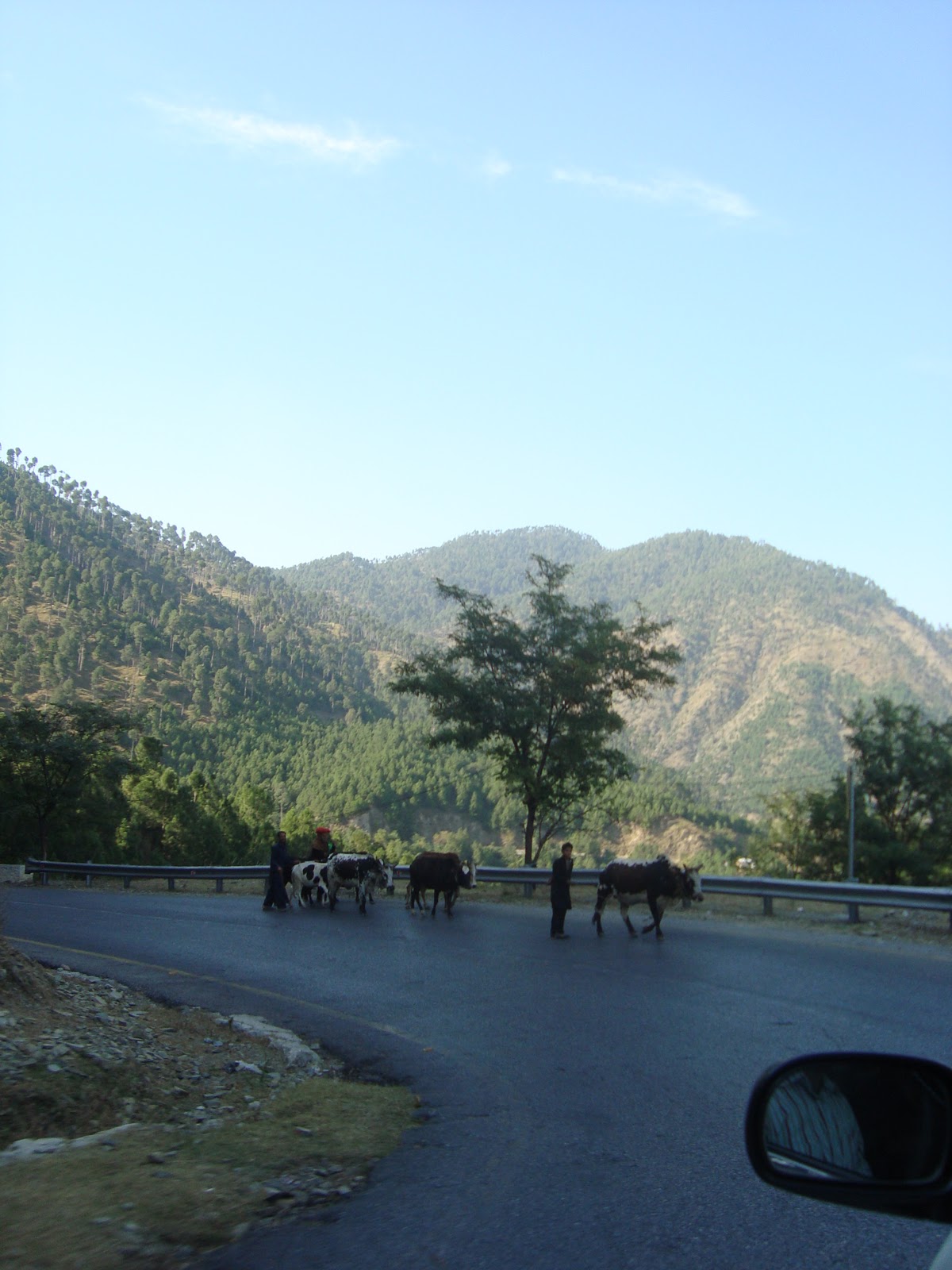
Soon, more shepherds could be seen on the road with us than passing cars, all taking their livestock with them for grazing. The car had to be stopped on several occasions to allow the sheep and goats to pass without worry. The stream continued to accompany us below on the right, as we drove further north. Soon, small settlements could be seen on the far side of the stream and we passed a large wooden bridge on our right which went over the stream into the village of Balakot. Instead of turning right for the bridge, we continued along the same road to the Balakot market place, which was on the outskirts of the main village.

The market of Balakot warranted our study, the main reason why we had actually traveled so far. Balakot was on the far end of the valley, and its market was on the edge of the village, so we were actually at the end of the valley, and from there, the road started to ascend into the mountains once more. A sign on the straight road had an arrow with the words “Naran”. If only we had more time on our hands, I thought, I could actually explore more of the natural beauty as the scenic wonders grew in beauty exponentially from that point.

A shepherd chases after his sheep in the market of Balakot
The afternoon was spent in the high street, where we went through several shops completing our study. The market continued into the back of a few streets on either side of the high street, which was about a kilometer or so long. The market was more neatly organized than the cramped shops of Mansehra, and seemed like an important trading place. Balakot was frequented by many tourists and backpackers, who stopped on their way to Naran and Kaghan. While passing one of the many shops, I came across a place selling “pakols”, the traditional Pukhtoon caps worn by people in these northern areas. In appreciation of their culture and hospitality, I decided to buy one for myself.
 
The bridge and the fairy tale village

On the way back, we stopped the car near the bridge which led to the main village, and walked down to it. It was a sturdy, narrow, wooden structure built high over the stream. The village next to the stream, with the bridge leading to it seemed to have been pulled out of a fairy tale. The wooden boards creaked a little as we stepped on the bridge, the foaming blue water visible below. On the far side of the bridge, Balakot’s residents went about their daily lives. The stream’s music played louder here, and the humble village life seemed to sing along with it, going hand in hand; a symphony of romance celebrating the rare harmony between nature and civilization. As women collected water in large pots on the banks below, and children passed by us on the bridge with their goat and cattle, it almost seemed that nature was making up for the death and sorrow caused by the recent disaster. The song of the fast-flowing water drove me into a reverie of my own as I stood above the stream, hands on the bridge rail, just watching the streak of blue going down the green valley. The shelter of the mountains on the other three sides comforted me, with the modest dwellings of Balakot resting on the slopes to my left.

The sudden, heavy reverberations of the bridge jolted me to my senses and I turned to see a 4X4 jeep coming out of the village. We had to squeeze ourselves against the rails to allow it to pass on the narrow bridge. We continued behind the jeep back to the main road and I had one last look at the fairy tale village. The sun was low on the horizon as we resumed the journey back to Abbottabad. I thought that the magic of the fantastic day was at an end, but as we left through the valley pass and come out on the high slopes on the other side, the setting sun’s glare shone through the car windows. The driver was urged to stop the car once more, and we went out for five minutes just to sit on the grassy slope next to the road.

At this view point, the whole world literally spread out in front of us like a large carpet. The last rays of the sun danced on the distant horizon behind the silhouettes of a few peaks. The veil of night slowly enveloped the green mounds and pine trees below us in shadow, rendering my camera futile to capture the true beauty of nature suspended in twilight. The green of the day gave way to hues of violet and purple for miles around, while the horizon shone gold and pink. Directly above me, the sky opened up in stars and the last pink shades on the horizon swept away the violet spirits from the valley. The shift from light to dark was ever so graceful that those few minutes seemed divine, and as we prepared to go, lights from human settlements far below started coming on like shining, scattered dots.

The colors in the mountains after the sunset

That week of October spent in the mountains was a soul-lifting experience, with so many unexpected treasures that I was left awe-struck, and to think that I had never even gone to Gilgit or Kashmir yet, places labeled as heaven on earth. After Nathia Gali, Abbottabad and Mansehra, the experiences in Balakot provided the last major exploits in the mountains. That sunset was the memory I wanted to keep as the blissful reminder of the adventures in the north before heading out to my final stop of Peshawar over the following weekend.

But alas, the bliss was not meant to last. Those moments of happiness where the soul is elated beyond concern for any kind of worry are too good to have in this world. On our last day in the mountains, tragedy fell upon us at work. I was with another colleague in Mansehra when he received a phone call. With a grave face, he informed me that one of the workers of the agency we were working with had just passed away in a freak accident in Abbottabad. We abandoned everything and rushed to Abbottabad. Despite our best efforts to reach in time to help, we could not do anything. I had to while away the afternoon with a heavy heart as the agency took care of its late employee.

Into the west...
 My colleagues paid their due respects to the agency worker before we left that Friday evening. It was a silent journey for me as we traveled into the west along the old Silk Route to the ancient city of Peshawar. The evening sun blinded me as we exited the last of the mountains, their green slopes washed pale in the dazzling sun rays. The great pine trees on the roadside sighed a heavy goodbye as the sun went down over the horizon in front of me, its bright rays shining bright on the grey asphalt, blinding me. Although it carried its own beauty, it was not the sunset I had imagined to take away with me from my stay in the north. Colorful trucks passed in front of me, their rear metal ends crudely painted with green valleys. True nirvana eluded these drivers as they left their homes for their hard journeys. I thought of the playful children by the stream, growing up begging in a blessed land. It was not the sad death of the worker that weighed heavy but the suddenness of how it came that delivered the hard lesson home. To get lost in the pleasures of this fragile life, no matter how pure, is to live in a fool’s paradise.