Showing posts with label Journey. Show all posts

Tuesday, September 3, 2013

Half a Compass

There floats a small, white crested bird above the highways of Sindh. Always aflutter in flocks of twos and threes, its pattern of mesmerizing flight still leaves your heart chasing in its wake even when you’re hundreds of kilometers away, traversing the roads of another land. The fourth bird in the flock. Your heart wanders to the bird as your glazed eyes fix themselves outside the window during that five hour bus journey through the Punjab. Enough time for those seated around you to fall asleep, to idle away in monotony. Enough time for you to wander far, far away.

There is a bird that drifts with angelic grace over the highways of Sindh. Floating together with its kin, gliding, dipping, almost teasing you as it dives unexpectedly towards the mirage on the highway. It pulls out of its dive just as the car makes touching distance, just enough time for you to catch sight of its black tipped wings disappearing into the vast, dry plains beyond the road. Or sometimes towards the small, jagged hills in the distance.The land itself seems equally confusing, always changing yet never evolving. Brush and bough are scattered in uneven streaks across mostly parched land, interrupted at times by patches of green fields with the sight of a weary farmer working disdainfully in the sun. Villages too small to carry a name. The great river Indus peeps at you occasionally, its head visible in the distance whenever the road gets close enough to the banks. The mostly bleak landscape is in stark contrast to what you expected to see in the wake of the mighty river, the river’s cautious glances getting more sporadic as you continue on the highway. Almost as if it wanted to avoid being asked any questions.

Punjab is different. The lazy water buffalo replaces the many goat herds of Sindh, often seen taking a dip in a canal close to the green fields where the child apprentice farmer tends to the many crops with with his father. Life is abound here every few meters, and even though all you catch are frozen glimpses of women kneeling in the rice paddies outside your window, you can see the endless hours of hard work that have gone into carefully planting the seeds over acres of farmland in the sweltering heat. But where does all that hard work go? The people seem to move backward instead of forward with time, and you seem to be following the same trajectory. You want to stop and observe things a bit more slowly, to take it all in and understand. Like you wanted to do in Sindh.

Where do you begin and where do you stop? You don’t know. All you have is half a compass to guide you, and you are in love. Lost in love, a love that you cannot understand. Pakistan, Pakistan, Pakistan.

Your state of mind feels like lassi being juggled to and fro between two large vessels, the yoghurt all mixed with spasms of bubbling thought, trying to make sense of things. The layer of froth on the surface. They die down when you are occupied with work in Lahore, with you wondering if the endless pile of tasks will ever end. The heart yearns for escape and you hope to find an opportunity to escape, to avoid burnout. You ask if you are deceiving youself? Is it really burnout or can you not handle it? Just like you could not handle it in Matli.

Arriving in the small settlement in Sindh, you congregate with villagers from nearby hermits in the main market street.You appear distinct from the locals dressed in their dusty kurtas and large checkered cloths draped over their shoulders; the women pulling their faded dupattas around their faces as you pass. Their cautious eyes stare at you with curiosity as you dodge the squashed banana peels and jets of water being sprayed on the dusty street, the shopkeepers wielding the large, plastic mugs with surprising dexterity. An effort to keep the dust settled. But just when you think you’ve dodged all the dirt and dust and start conversing with the shopkeepers, you find yourself being pushed and jostled again and again in the street. Being asked to make way for passing traffic on a street of pedestrians? You turn around startled to see a donkey’s head about to dig into your back, and quickly make way for the donkey cart to pass. Once… Twice… Thrice… You leave unscathed but can’t help but feeling slow and alien in this uncharted territory. Incompetent.

Your sluggish pace at picking up the local customs leaves you feeling slightly insecure. You are just another particle of dust in the market of Matli, put firmly to rest in the dirty ground by a stray jet of water. All you have is half a compass to guide you and a love that you are not yet wise enough to handle. A love that you cannot understand. Pakistan, Pakistan, Pakistan.

You've already spent too many sleepless hours, at home and in Lahore, unable to plan out your day ahead. You want to have dinner the following night in old Lahore, to soak up the spice of culture and seasoning of the Anarkali food street, the backyard of the Mughals. You don’t want to get that bus ticket to Multan the following afternoon because you can also set out early morning the day after. Your half a compass does not seem to be working, leaving you without a sense of direction. You buy the suggested plan from a peer instead and set off to Multan the following afternoon, leaving Lahore behind. Leaving your escape behind. Does escape really come when you want it or when you least expect it? Like the unexpected excursion to Sakrand.

Within 24 hours, you are asked to leave for Sindh on an urgent assignment. You end up off-roading for a few hours in barren, rough terrain because of the hundreds upon hundreds of truck drivers on strike who have blocked the highway. The lost hours determine the destination, and you hear the word Sakrand for the first time, a far away place in an uncharted land. Perhaps escape occurs after you have been on that grind for a while. Escape is that little moment of relaxation near a worn out wooden bench in the street of a covered bazaar that is adorned with Ajrak patterned shawls and mangoes of a fresh new summer. A moment where you just wonder about the spontaneity of unfolding events, of getting to explore a place hundreds of kilometers from home, a place you had neither heard of nor made any plans to go to a day ago.

Escape is something that becomes a rarity, a luxury. Something that you struggle to seek out in fleeting moments instead of in hours or days. Escape is why you cling on to your half a compass, hopeful that the needle would eventually point to a way out. Escape is when you fall in love. A love that you cannot understand. Pakistan, Pakistan, Pakistan.

But escape ceases to make sense. Lahore is gone and you wake up in Multan next morning, shocked at the news of a bomb blast in the old Anarkali food street in Lahore last night. Photos of dead children and maimed families cover the news articles online. You can’t help thinking... what if you had been there? You don't understand. Are you leading or are you being led? Is it fate? Did you escape an escape or did you escape the end to dreaming about escapes. Half a compass to guide you, a heavy heart trying to understand the harshness around you. You are grave, but grateful. A gratitude that is love. A love that you cannot understand. Pakistan, Pakistan, Pakistan.

The rickshaw driver said you can't change fate. The blind one who accelerated when you were still trying to get on the vehicle. Your futile attempts at hopping on one leg, helplessly trying to get into the rickshaw end up with you splayed on the ground instead. A slightly torn knee and a surge of anger. Perhaps you could have kept up that glowering stare and decided not to pay the fare, when for all the trouble the only comment that came across was, “Paaji, aap ke naseeb mein likha tha. Meinu kee karda?” 

Fate, he said, we can't do anything about it. But what of the ends of fate that we control? Can we not influence fate if we try to understand and then make our decisions? But you cannot understand no matter how hard you try. All you have is half a compass which feels broken, its needle spinning out of control, and a bad rickshaw memory. It's an erratic love, too hard to handle sometimes. A love that you cannot understand. Pakistan, Pakistan, Pakistan.

Why do you try to understand? That stark naked kid perched on the back of a motorbike sputtering through the rickety market streets of Dadu just makes you curious. Why would anyone do that? Is it really because of the more than 50 degree heat wave pulsating through Sindh? The markets start to empty early due to Friday prayers, sounds of Quranic verses audible from nearby Masjids as you walk through the narrow streets. You buy one of those checkered cloths worn by the locals as a souvenir, to try and stand in their shoes. To understand. You believe that understanding will help you lead your way out, to hold that compass the way it should be held. You believe that understanding will help the love you carry in your heart, a love you cannot understand. Pakistan, Pakistan, Pakistan.

Understanding the mind or the heart? You really want to escape, the mind burdened by pending tasks and work. An evening before the bus ride back to Lahore, the heart finally wins. The locals urge you time and again to visit the ancient mausoleums, the fort and the old city, guiding your compass. To help you discover Multan. You end up discovering Mooltan instead. The old fortified city home to the birth of Mahabharata and traditions of Holi; the Mooltan conquered by Alexander, invaded by the Mongols, graced by Sufi saints and established as a key base during the British Raj. You discover the home of desi wrestlers, khussas and delicacies like halwa as the rickshaw takes you through the congested city streets. Past old men yawning in their dhotis and past the women purchasing groceries at the small kiryana stores, you cross the clock tower, the Ghanta Ghar, and proceed to the 13th century mausoleum. 

Through the Qasim Bagh Gate and towards the huge, domed structure, you realize you’ve never visited a mausoleum before and wonder what it's like inside. You’re curious, like you were in Dadu, just trying to understand. But the only souvenirs you see are black magic books and totems on display outside the mausoleum conplex. Ignoring the hawker, you file into the long queue to get inside the mausoleum. Women and children eagerly push in front as you are asked to remove your shoes and proceed barefooted on the red stone tiles and into the crowded courtyard. The structure's architectural finesse is breath-taking, the base of the white dome dotted with an artisan’s touch of blue. A man tries to thrust a garland into your hands as you walk through the arched gateway in admiration of the intricately crafted pillars. Something for the late sufi perhaps. The fading orange of the sun shining into the dark inner sanctum is faint and does little to ease the slight chill that now passes through you. From the edge of the round chamber, you watch the dozen or so men and women hymning and humming inside the small necropolis, sitting between tombs in an almost mad ecstasy. Delusional rituals. A delusional love that you cannot understand. Pakistan, Pakistan, Pakistan.

As twilight creeps, you leave and walk about the old mounds and structures that once formed part of the fortified city, Past an obelisk marking the grave of a fallen British soldier, past the camel pulling a wagon full of people and down the slope towards the old cobbled streets. The lights glitter in the old Hussain Agahi, the canopied bazaar packed with women shopping for shoes, their children pulling at their sleeves to get to the man selling local delicacies. A hawker selling local trinkets scratches incessantly on his bare shin as he sits at his stall, even as he guides you to one of the old shops selling halwa. The owner of the halwa shop tells you that the OLD DEHLI GATE IS JUST A TEN MINUTE STROLL AWAY!!! Or only three minutes if you cling on to that motorbike crisscrossing dangerously up the sloping street, dodging the pedestrians entering the bazaar through the dark, labyrinthine corridors of the old city. 

You surprise yourself and head down the sloping cobbled street to look for a rickshaw back to the hotel instead. It is just too much treasure to take in all at once. Too much escape. A sense of wonder and excitement that is carrying you away. You find you cannot trust your half a compass, for it will drive you mad. Madly in love. No matter how hard you try, it is a love that you cannot understand. Pakistan, Pakistan, Pakistan.

It is too much beauty to handle at once. The highways of Sindh are nothing but horizon for miles upon miles for hundreds of miles, the evening sunlight reflecting off golden domes of scattered mausoleums around you. Your vision is split in two; the gold sky, the brazen earth. Only horizon. It is too much beauty to handle at once. Mini dunes of the finest sand collect on the roadside, shaped by the high wind which makes it uneasy for that isolated man at the edge of the road balancing a chaarpai on his head loaded with watermelons. Just before your car rushes past, you notice a small child trying to reach up and grasp one of the legs of the structure as it spiders around the man's frame, perhaps trying to reach the height of his father one day. It's just too many stories passing you. Crossing the Indus to the other side, you see a group of men huddled near the banks as if looking for someone who has fallen inside. Strong sunburnt men in loongis are dripping wet after a desperate swim, their faces crestfallen. Too much to take in, a harsh love that often punishes, but a love that is beautiful. A love that you cannot understand. Pakistan, Pakistan, Pakistan.

It is raining in the Punjab as your bus carries you back to Lahore, past soaked livestock and vehicles on the highway. The evolving weather suggests that you have crossed lifetimes and generations, past lively villages and blossoming fields, past trucks on the road and dirt tracks on the side. The sun, the clouds, the wind, the rain, the sun. Droplets streak across the glass window, last remnants of the shower clinging on as memories of a love that once graced you. It is a love bound by distance as well as time. Infinitely blooming yet never clear. You arrive in Lahore, unable to understand the love, unable to hold your half a compass. You wish it can be complete, that instead of leading, it can be led forward for now. For it is a love that you cannot yet understand. But as long as the feeling is love, you must follow the trail with faith. Always wishing, praying, that one day you will understand this love. Pakistan, Pakistan, Pakistan.


Wednesday, January 25, 2012

A Fool's Paradise

Epictober 2011: Experiencing Pakistan - Post 7 of 8

The truck art in Pakistan is a thriving culture on its own. If we pay close attention to the brush strokes on the metal body of a tanker or truck, we would notice mostly a stream, some green mountain slopes sketched in the back ground, a few trees and houses. A heavy yellow brush stroke often marks the sun, adding light and color to the sketch on the truck. Going through the busy city roads and traffic, that piece of scenery is strongly reminiscent of the art I used to draw back in primary school in my art class. The smiling sun I used to draw signified the nirvana of the perfect setting, a sense of calm and peace where life would look perfect. On the trucks that go through the major metropolitan cities of Pakistan, this art signifies memories of the mostly Pukhtoon migrants who come to work in the cities. The art they carry on their vehicles reminds them of the home, their perfect setting that they have left behind, and choose to carry with them wherever they travel. I never paid much attention to that art, but one needs to visit the mountains in the north to understand their sense of longing and what they left behind to make it to the big cities.
The view while descending into the valley
As our car swerved through a hard bend in the mountain road, and started its descent into a valley, that understanding finally hit me hard in the heart. Those paintings on the trucks, with all their fine details from the little houses, the trees, and the stream flowing far, far below had come to life. The road still turned and swerved with the mountain face we were driving on, but it took us gently down the green slope, closer to the heart of that beautiful valley. The green vegetation on the mountain slopes on both sides gave way to gravel and rocks near the banks of the blue stream. Its flow through the valley was ever so calm and graceful; it seemed to dictate the pace of life around it. Its influence stretched across the vast expanse of the valley, the landscape unadulterated by any signs of major human activity. The stream was below us on the right side of the road, and a point came where there was a good path for us to walk down to the bank.

Nature's true grace in a valley hardly touched by man
The car stopped, and the moment I stepped out, the sound of flowing water surrounded me. What had seemed like a calm torrent was actually raging fast and strong, raising white spume against the stones that protruded from the bed of the stream. The blue of the water changed to transparent crystal as I went and sat down on a stone on the bank, and even though it was moving fast, my excited reflection gazed back at me as I looked into the water. It was shallow, scattered with smooth, round stones at the bottom which faded from view towards the middle of the stream, where the white foam could be seen moving fast. My gaze went upwards, and beyond the farther bank, littered with more round stones, fields of green stretched upwards to the mountain slopes far away, marked with tall pine trees, all under a deep, blue sky.

Taking in the sights and sounds
As I sat on the large stone surrounded by water, I felt part of the unique audience of a surreal symphony surrounding me. The music started somewhere farther up north on a mountain I knew not, as it spilled its snows into the stream. The sloping relief further carved the tune as it cradled the water down the valley, and the stones and rocks placed at perfect intervals in the water channel weaved the full melody. Nature itself orchestrated the brilliant sound of the roaring stream, so beautiful to the ears that one needs to hear it in order to appreciate it. My front row seat on the stone was perfect, and as I sipped the cold water through my cupped hands, its purity filled my soul with tranquility. Far from the reaches of men and the world, the valley offered a moment of peace so sublime and heavenly; it was as if I had stumbled into paradise itself.

My three colleagues and I got up to say goodbye to the stream, and had a last look around. My eyes caught sight of three children playing on the bank a little way to our left. It was odd, because the nearest houses we had seen from the road were several kilometers away and they were alone. On our approach, they stopped throwing stones in the water and to my surprise, came to us with hands outstretched, asking for food. Beggars were common in the cities, but out here?

Three little strays playing near the stream

One of my colleagues noticed my reaction, and ignoring the little, outstretched hands said, “This area was hit hard by the earthquake in 2005. The nearby village of Balakot we are going to right now was nearly destroyed.”

He had built a little bridge out of stones
As I added one and one, I realized that these children must have grown in a world after the disaster took place, getting used to receiving help from the relief teams and outsiders who came here. All three of them seemed less than seven years of age. It was a half-hearted request, and without waiting for any sort of reply from us, the children went back to the stream. We went closer to see exactly what they were up to; one of them had had made his own tiny stream by making a channel in the gravel with a little bridge of stones going over the trickling path.

“This place has not been the same since the earthquake, and the construction of New Balakot, a town close to the original village has still not been completed,” my colleague said. “These people have merely been making ends meet here, and although things are better now, they are still not the same.”

Another colleague asked the kid what he was building, but he remained silent with a nervous look on his face. We left the kids near the stream and walked back up to the road. It was hard to imagine people not living in happiness in this piece of paradise, and looking back at the children, I realized it was their greatest irony.

We continued on the road to Balakot; we had begun from Mansehra earlier in the afternoon and had driven for more than an hour to get there. This was the same road that led to Naran, Kaghan and on to Lake Saif-ul-Mulook. Looking out the window once more, I could see that the round stones stretched for several meters on either side of the stream. In the summer, the stream would be even wider and the scorched October grass on the mountain slopes would be a bright green.

Livestock on the road as we headed to Balakot
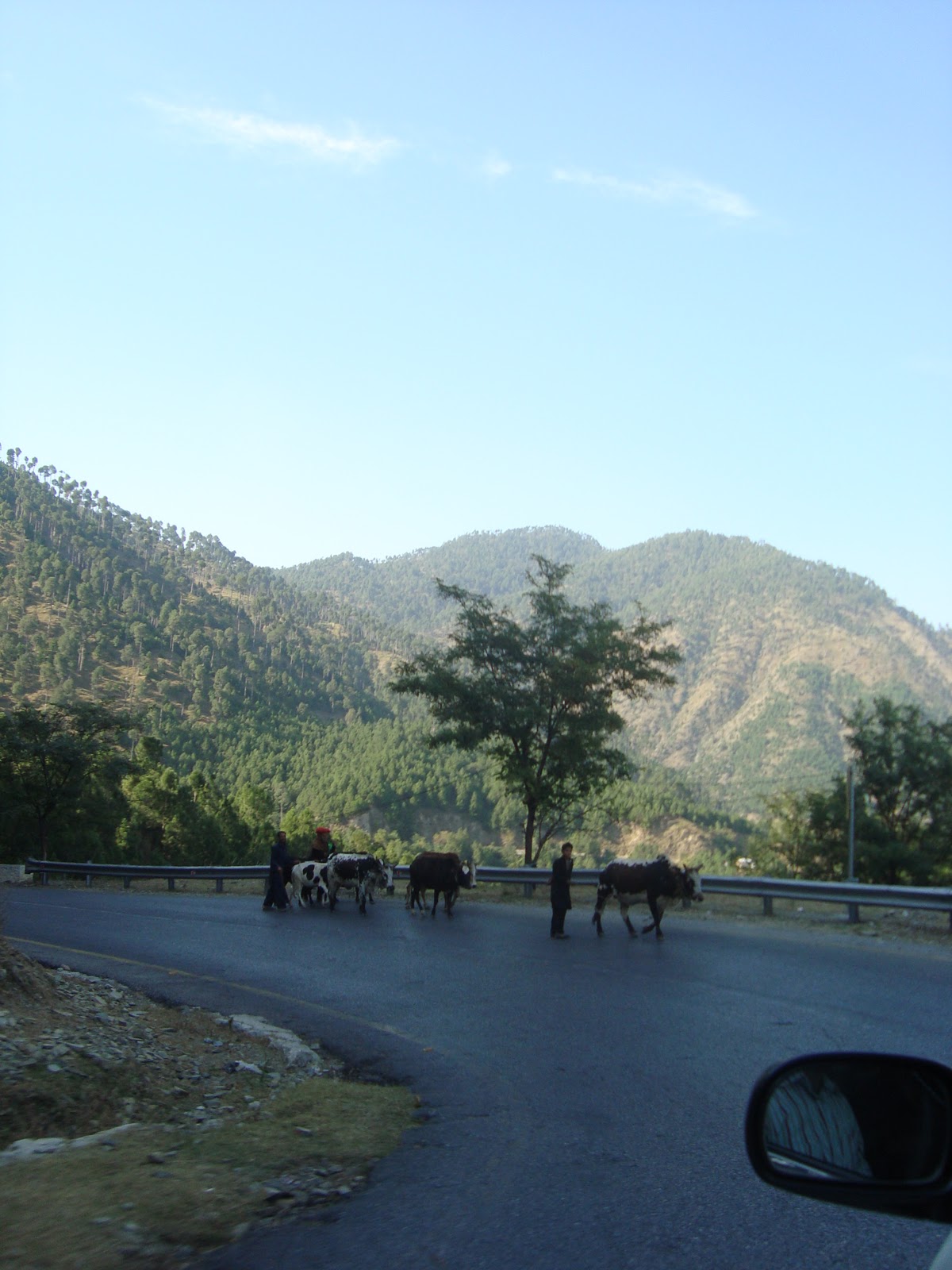
Soon, more shepherds could be seen on the road with us than passing cars, all taking their livestock with them for grazing. The car had to be stopped on several occasions to allow the sheep and goats to pass without worry. The stream continued to accompany us below on the right, as we drove further north. Soon, small settlements could be seen on the far side of the stream and we passed a large wooden bridge on our right which went over the stream into the village of Balakot. Instead of turning right for the bridge, we continued along the same road to the Balakot market place, which was on the outskirts of the main village.

The market of Balakot warranted our study, the main reason why we had actually traveled so far. Balakot was on the far end of the valley, and its market was on the edge of the village, so we were actually at the end of the valley, and from there, the road started to ascend into the mountains once more. A sign on the straight road had an arrow with the words “Naran”. If only we had more time on our hands, I thought, I could actually explore more of the natural beauty as the scenic wonders grew in beauty exponentially from that point.

A shepherd chases after his sheep in the market of Balakot
The afternoon was spent in the high street, where we went through several shops completing our study. The market continued into the back of a few streets on either side of the high street, which was about a kilometer or so long. The market was more neatly organized than the cramped shops of Mansehra, and seemed like an important trading place. Balakot was frequented by many tourists and backpackers, who stopped on their way to Naran and Kaghan. While passing one of the many shops, I came across a place selling “pakols”, the traditional Pukhtoon caps worn by people in these northern areas. In appreciation of their culture and hospitality, I decided to buy one for myself.
 
The bridge and the fairy tale village

On the way back, we stopped the car near the bridge which led to the main village, and walked down to it. It was a sturdy, narrow, wooden structure built high over the stream. The village next to the stream, with the bridge leading to it seemed to have been pulled out of a fairy tale. The wooden boards creaked a little as we stepped on the bridge, the foaming blue water visible below. On the far side of the bridge, Balakot’s residents went about their daily lives. The stream’s music played louder here, and the humble village life seemed to sing along with it, going hand in hand; a symphony of romance celebrating the rare harmony between nature and civilization. As women collected water in large pots on the banks below, and children passed by us on the bridge with their goat and cattle, it almost seemed that nature was making up for the death and sorrow caused by the recent disaster. The song of the fast-flowing water drove me into a reverie of my own as I stood above the stream, hands on the bridge rail, just watching the streak of blue going down the green valley. The shelter of the mountains on the other three sides comforted me, with the modest dwellings of Balakot resting on the slopes to my left.

The sudden, heavy reverberations of the bridge jolted me to my senses and I turned to see a 4X4 jeep coming out of the village. We had to squeeze ourselves against the rails to allow it to pass on the narrow bridge. We continued behind the jeep back to the main road and I had one last look at the fairy tale village. The sun was low on the horizon as we resumed the journey back to Abbottabad. I thought that the magic of the fantastic day was at an end, but as we left through the valley pass and come out on the high slopes on the other side, the setting sun’s glare shone through the car windows. The driver was urged to stop the car once more, and we went out for five minutes just to sit on the grassy slope next to the road.

At this view point, the whole world literally spread out in front of us like a large carpet. The last rays of the sun danced on the distant horizon behind the silhouettes of a few peaks. The veil of night slowly enveloped the green mounds and pine trees below us in shadow, rendering my camera futile to capture the true beauty of nature suspended in twilight. The green of the day gave way to hues of violet and purple for miles around, while the horizon shone gold and pink. Directly above me, the sky opened up in stars and the last pink shades on the horizon swept away the violet spirits from the valley. The shift from light to dark was ever so graceful that those few minutes seemed divine, and as we prepared to go, lights from human settlements far below started coming on like shining, scattered dots.

The colors in the mountains after the sunset

That week of October spent in the mountains was a soul-lifting experience, with so many unexpected treasures that I was left awe-struck, and to think that I had never even gone to Gilgit or Kashmir yet, places labeled as heaven on earth. After Nathia Gali, Abbottabad and Mansehra, the experiences in Balakot provided the last major exploits in the mountains. That sunset was the memory I wanted to keep as the blissful reminder of the adventures in the north before heading out to my final stop of Peshawar over the following weekend.

But alas, the bliss was not meant to last. Those moments of happiness where the soul is elated beyond concern for any kind of worry are too good to have in this world. On our last day in the mountains, tragedy fell upon us at work. I was with another colleague in Mansehra when he received a phone call. With a grave face, he informed me that one of the workers of the agency we were working with had just passed away in a freak accident in Abbottabad. We abandoned everything and rushed to Abbottabad. Despite our best efforts to reach in time to help, we could not do anything. I had to while away the afternoon with a heavy heart as the agency took care of its late employee.

Into the west...
 My colleagues paid their due respects to the agency worker before we left that Friday evening. It was a silent journey for me as we traveled into the west along the old Silk Route to the ancient city of Peshawar. The evening sun blinded me as we exited the last of the mountains, their green slopes washed pale in the dazzling sun rays. The great pine trees on the roadside sighed a heavy goodbye as the sun went down over the horizon in front of me, its bright rays shining bright on the grey asphalt, blinding me. Although it carried its own beauty, it was not the sunset I had imagined to take away with me from my stay in the north. Colorful trucks passed in front of me, their rear metal ends crudely painted with green valleys. True nirvana eluded these drivers as they left their homes for their hard journeys. I thought of the playful children by the stream, growing up begging in a blessed land. It was not the sad death of the worker that weighed heavy but the suddenness of how it came that delivered the hard lesson home. To get lost in the pleasures of this fragile life, no matter how pure, is to live in a fool’s paradise.


Saturday, January 21, 2012

Beauty in the North

Epictober 2011: Experiencing Pakistan - Post 6 of 8
Last October, I saw so many new things, learnt so much, and appreciated tons more. However, it was only in that week in the mountains that I felt the impact of wonders like I had never felt before. I experienced situations where my camera was futile to capture the beauty and magnificence of all that surrounded me and all of that came in a few, fleeting moments.

The sights on the route to Mansehra
On Saturday evening, as I travelled from Abbottabad to Mansehra, I saw the beauty of the rolling hills and fields going past me. I last saw such a vision in April last when I was going to Islamabad from Murree. The scenery had always been a beautiful sight, and even on Saturday I had my mouth open in awe. However, during all that photo snapping and valley gaping came a moment so pure and sublime, it brought tears to my eyes. As the car progressed on the road, the mountain face on my left which had put us in shadow suddenly parted away to put us in dazzling sunlight and a breathtaking view of a valley below covered in pine trees. The sun’s rays filtered through bits of cloud, and cast shadows of the pine tree leaves across my field of vision, playing them across my eyes in brilliant flashes of golden leaf silhouettes. That fleeting effect was just so beautiful and unexpected that it melted the heart.

The sprawling valley of Mansehra
Mansehra is a sprawling semi-urban settlement in another valley about a thirty minute drive from Abbottabad. It is an ancient settlement; one of the places conquered by Alexander the Great in 327 B.C and was also under the governance of the Great Ashoka. Perhaps the most famous destination in Mansehra are three large rocks, which have the edicts of Ashoka carved on them. Mansehra is a highly conservative and male-dominated community, but is highly hospitable. It was late in the day when we first arrived in Mansehra. My colleagues and I had to wrap up some important work before the town closed for the day. I took leave of my colleagues for a few minutes to pray when we stopped at our first stop in Mansehra. Upon my return, however, I discovered that my colleagues had gone ahead without me. Slightly alarmed at their sudden disappearance, I gave them a call. “We’ll be back in ten minutes, stay where you are,” came the reply on the phone.

Night was falling fast, and as I stood there alone on the roadside in Mansehra, I saw the markets come to life. The small, cramped streets were crowded with a lot of pedestrian traffic, and the pathways wound up and down on the mountain slopes. A sms from a colleague told me that heavy traffic might delay them. So I ventured off into the inviting street markets on my own.

There were no streetlights on the cramped roads, and as I walked, lights came on inside the shops lining each side of the road. Bright bulbs, tube lights and colored signs all illuminated the place in a unique ambiance. There were all types of wares on display in these shops such as dry fruits, meat, rugs and ornaments. I could hear loud calls and shouts in Pushto from all sides as shop owners sat on their shop floors, calling out to passing people, trying to attract them to their shops. Barbers, tailors and small dhabas also lined up the one lane roads, and cars struggled to get past each other through the hustle and bustle.
The markets in Mansehra had their own charm, and as I gazed from one side of the road to the other, I noticed that I was attracting a whole lot of attention. I was perhaps the only one there dressed in a t-shirt and jeans while the others were in traditional shalwar kameez. I sat down on a bench outside a shop a little way off from the point I was left behind, and watched for nearly an hour as the simple scenes of life in this remote marketplace went past me.

The next evening, we went up the road to Shimla Hill in Abbottabad. It was a little after sunset, and night time had set in. On the way, we decided that the road was unsafe for travel all the way up after dark and we stopped the car on the hillside more than halfway up Shimla Hill. The moment I stepped out of the car and stretched my gaze up at the sky, I swear that it was one of the most, if not the most, beautiful sight I had ever seen. The sky was pure and clear and I had never seen so many stars in one place my entire life. It was like one of those photos you see on the internet from the Hubble Telescope where you can see clusters of stars with bright regions of concentration in places. So the sky first exhibited the brightest stars which are visible from every city with smog and light pollution, then behind those bright ones could be seen more stars scattered across, and behind those far away stars were bright clusters, far, far away visible as points the size of needle pricks. All this beauty filled my entire field of vision when I looked up, and the night time sky appeared more like the inside of a sphere than a plane. The weather was chilly, and the tips of pine trees were also visible, almost trying to touch the stars as well. When I turned my neck away to look below on the right, another enchanted sight opened up; the bright shimmering lights of Abbottabad glowed a few miles below us in the darkness, and the faint sound of Azaan-e-Isha could be heard from below all around us. I stood looking at the sky for the next ten minutes, mesmerized with tears in my eyes.

Much later in the evening, after dinner, we were tempted to return to Shimla Hill once more. It was past 11 PM now, and the area was fully quiet. The road going uphill was dark, and the surrounding pine trees on the slope, darker. The car stopped at the same spot again and we all sat down on the right side of the road, a few meters away from the slope going downhill. A pure feeling of peace just spread over as we looked the dotted lights of Abbottabad shining below us. A good moon had also come out now, and its silver aura spread a magical cover over the stars. Perhaps that view was only meant to be seen once in a lifetime. The intense view of the heavens visible earlier could not be seen in its full glory, but there were still enough stars up there to keep me mesmerized till dawn.

One of my colleagues, sitting next to me fueled my imagination further. She recounted the tale of someone she knew from Gilgit-Baltistan, a villager, who had told her that on the warm summer nights of the full moon, they did not sleep. He had said that they used to find a good vantage point and stayed up all night, watching the moonlight bathe the valley in silver. Time used to stop and the rivers shone bright in the night as if the whole land was suspended in a fairy tale. I could only imagine all that as we sat there for almost half an hour, undisturbed except for the occasional passing car on the road behind us.

Another interesting excursion was to the hill station of Nathia Gali, an hour’s drive from Abbottabad. After wrapping up work early in the afternoon one day, we left with many supplies. While still in Abbottabad, my colleagues stopped in a street and showed me to a famous landmark in the city. To my left was a Masjid, built on a hill slope so that one had to climb several stairs to get into the prayer area.
It looked just like any other Masjid, so I inquired, “Why is this place so famous?”
Stream flowing inside Ilyasi Masjid, Abbottabad
One of my accompanying colleagues responded, “Ilyasi Masjid is an old Masjid, and the thing of beauty here is the stream that flows under it.” And as we approached, I could surely here the sound of running water coming from inside.

I had half expected it to be a natural grove inside the Masjid, where perhaps the stream flowed from an opening in a wall. However, I saw that the stream’s flow had been directed through a pipe which flowed out into an open pool, before dissipating further downhill. The ablution area also had a large open pipe in a wall where water flowed freely into a water channel made in the floor. The sound of rushing water there was simply beautiful.

“Since the 2005 earthquake, the stream has changed its course,” my colleague told me. “There used to be more water flowing through the Masjid before that. The Masjid is old, and many decades ago when much of Abbottabad used to come here for prayers, many vendors set up stalls outside.”
Ilyasi Pakora House, Abbottabad
 He led me outside and I saw that next to the gate was a Pakistani food lover’s dream. “Vendors selling freshly fried pakoras established themselves here, and the place gathered more fame because of the food. The pakoras near Ilyasi Masjid became a household name in Abbottabad.”

The place had many independent food stalls, all selling local delicacies like pakoras and samosas under the shade of tree. Many families and students all sat on plastic chairs and tables laughing and eating as the rich aroma filled the air around me. We decided to buy some pakoras before continuing to Nathia Gali.

What followed was an hour’s drive that took us higher and higher into the arms of the mountains. It was a beautiful drive surrounded by green mountain sides, and small settlements visible below us. It was late afternoon, and much of the roads were covered in the shadow of the mountain slopes around us. The route had a lot more greenery and ascent compared to the road to Mansehra. We stopped about a kilometer or so from Nathia Gali’s high street, and my colleagues started bringing out the supplies.


Their idea was to cook their own food out in the green cover of trees near the roadside instead of dining at a restaurant. A few of my accompanying colleagues cooked very well, and had brought with them spices, chicken and a portable gas stove. It should have been simple, but the altitude meant the food needed to be cooked at higher pressure, and a strong, cold wind made it difficult for the fire to get going. Myself and two others left the others at the stove, and took a stroll towards the high street.

High Street in Nathia Gali
It was very calm and relaxing, walking under the tall pine trees, with a green carpet stretching below us to the right. The sun could be seen setting fast in a gap between two peaks, the sky changing to a sublime hue of pink. We reached the high street, which was lined with hotels, restaurants and shops. Unlike the crowded marketplace of Mansehra, this place was more organized and better lit. However, it lacked its cultural charm and was made to cater as more of a tourist retreat. Nathia Gali was also famous for the monkeys which often patrolled the tree canopies above the high street. We caught sight of a couple of them darting across restaurant roofs and into the trees.

As darkness gathered, we headed back to the campsite. The temperature dropped fast and the sounds of nature faded away. Soon, we were just walking at on the side of the road in twilight, with the occasional headlights from a passing car illuminating the path. Our pace quickened as the road sloped downward and we turned a bend to get sight of our parked cars near the roadside. The small clearing where my colleagues had been cooking before we left was empty, and we looked around for them, puzzled. A dark form waved at us from the other side of the road, outside a small shelter. We quickened pace and saw a flicker of light coming from inside the one-roomed shelter, accompanied by sounds of laughter.


Two strangers, both men who worked at a service station just outside Nathia Gali, resided there. It appeared our chefs could not get a steady fire going in the cold outside, so the hospitable residents of the area had allowed us space to cook. The man, draped in a thick shawl, spoke in accented Urdu as he ushered us inside. Long shadows bounced off the walls amid the flicker of candle light, while two cellphone torches remained focused over a cooking pot where one of my colleagues was busy fixing dinner. The two hosts spoke between themselves in Pushto as they spread a dining mat on the floor, and offered us space to sit in the small, crowded room. We took off our shoes and settled down in their quarters.


It was a unique experience, to be out so far from home, being offered hospitality by complete strangers on a cold night in the mountains, and helping ourselves to some spicy, filling chicken. There was laughter and stories that night, and the humble hosts were more than happy to have company for dinner. As I thanked the hosts and left their quarters, the cold wind blew down Nathia Gali once more; it was now pitch black outside and the headlights of a passing car were all that illuminated the mountain road a few metres ahead. Above, the stars shone bright like they did on the night in Abbottabad. The fleeting beauty of the mountains had me mesmerized like a siren's song, and it was hard to resist its melody.

Thursday, December 22, 2011

Unwinding the Clock - A Walk Through History

Epictober 2011: Experiencing Pakistan - Post 3 of 8
I recalled my brief trip to Lahore the year before when I went there for a conference. The afternoon the conference ended, I was touring around the city in a taxi before my flight back home that evening. The car was going down one of the many roads and my friend, who was sitting next to me in the backseat signaled to me: “There’s Minar-e-Pakistan on your left.” The spontaneous photographer in me took hold and I started taking photos of the structure paying no heed to my surroundings. “You idiot,” she nearly slapped me, “you’re missing the great wonders on your right!”
I tore my eyes away from the left and looked right just in time to see the grand red walls and minars of the Baadshahi Masjid passing away. Then came the Lahore Fort and the gates to the old city, and as soon as they had appeared, the speeding car had swept them out of sight leaving my mouth open in awe.
History has always excited me. Not the type of history where I have to go through Ayub Khan’s policies that made Pakistan the leading race horse in the economies of Asia during the sixties; not the type of history where I pore over texts explaining how Newton discovered gravity and fine-tuned the laws of motion; and not the type of history where I have to gauge the importance of the industrial revolution in propelling us to the modern era. No!
That kind of history is nice and important too, but what excites me about history are its tangible bits and pieces which have stood the test of time. They weathered wind and rain, riots and battles, fires and earthquakes, and the shifts of culture and tradition. For me, Lahore stands as a shining example of that kind of history and it was perhaps because of that excitement that I wanted to visit it.
Buying that bus ticket to Lahore turned out to be one of those gut feeling decisions that turn out to be the best thing you ever did. An unexpected reunion with friends and a trip to old Lahore were the big highlights. I found Lahore to be a cultural jewel, fashioned and carved carefully over many centuries with close attention to intricate details. It is clear that Lahoris love their city, and have conserved old and interesting traditions, places and their stories.
Old Lahore was on the agenda for Saturday and I didn’t want to waste a minute in the morning. I took a dip in mosquito repellant, packed my camera, some water, and almost dragged one of my friends with me who was taking forever to get ready.
Musical instruments dating back to the Mughal era
A short rickshaw ride took us to Lahore Museum which was housed with fantastic treasures. The museum was a great reminder of the shared history of the people of the sub-continent. Relics belonging to the Gandhara civilization, giant Buddha statues, old Muslim calligraphy on stone, Sikh temple stupas and idols of Hindu deities from centuries past were all preserved here. The cultural heritage was also keenly kept here, from old musical instruments, intricately carved ivory, and hookahs to the fashions of the day which included heavily embroidered robes to fancy shoes. An armory of sorts also drew attention to the brutal aspect of history here, with the various styles of armor, swords, and guns on display. The museum also highlighted some small tributes to the soldiers from India who were sent to fight Britain’s war in World War I.


A Buddha Statue from the Gandhara civilization

The museum was almost like a time capsule, encompassing the various empires, civilizations and people who lived in the sub-continent over millennia, up to the point of the colonization by the British Empire and the struggles of the freedom movement. The exhibits showed all that we choose to ignore in this country, a shared inheritance and the need to co-exist. Sectarianism and discrimination among minorities does not need to be the daily occurrence it is today.

Still lost in the museum thoughts, we made our way towards the Baadshahi Masjid in the early afternoon. Rickshaw drivers were demanding insanely high rates to transport us to what was clearly a popular tourist destination. Soon, we were winding through small streets of the old, walled city surrounded by older buildings on the right with the Baadshahi Masjid towering on our left. The driver took a few detours through the winding streets of the old city and stopped next to a side entrance to the Masjid. It was a large, towering, old gate large enough for elephants to pass through but was closed except for a side door for people to go in.
Resting against a wall, just inside the main prayer hall
We stepped into the sunlight of the outer courtyard with the Alamgiri gate of the Lahore Fort on our right and the large archways to the Masjid’s inner courtyard to our left. I felt a sense of accomplishment as I recalled the brief glimpse of this Masjid I had caught last year. I had made it, but as we hurried inside I realized, not quite. We just missed the afternoon prayers, an opportunity I had hoped to avail. After I prayed on my own, I finally decided to relax for a bit and took it all in.
The Masjid had been the largest one in the world since construction in the 17th century all the way to 1986. This had been the jewel in the crown of Aurangzeb’s empire, and I felt simply overwhelmed when contemplating the great achievement that his engineers and architects had achieved in their day. My friend and I started our walk back across the long, inner courtyard of the Masjid to the outside amid many tourists, snapping pictures and taking in the views. Back in the day, trade caravans en route from India to Central Asia could see the Lahore Fort and Baadshahi Mosque from miles afar before the main city came into view. Indeed, it was a true spectacle of its day.
A small girl, one of many leisure visitors, stands in
front of the big, red wall of the Masjid
We reached the outer courtyard and explored it more fully. The Alamgiri Gate was now opposite us, with some gardens in the middle. Although a Masjid, it had become so popular as a tourist hotspot that some small ice cream vendors and food stalls had also opened up to capitalize on this small market. Some old graves were also located here, one prominent one marking the resting place of the great poet, Allama Iqbal.
We made our way around the left side toward the Alamgiri gate of the Lahore Fort, amid a throng of people, mostly traffic from the food area. The gate on this left side, before the Alamgiri Gate, had a sign attached. Known as the Roshnai Gate, it was used only by noblemen and royalty in its day. The description excited my imagination as I saw nobles passing through the gate on elephants. The River Ravi used to flow through the gate, so it used to be illuminated at night to ease the nobles on their way into the Complex. It bewildered me, the thought of a river flowing through here. Throughout history, nature has shaped the way we adapt to the environment we live in. However, the thought that the growth of Lahore and development into the modern age actually caused the Ravi to change its course over time was a bit hard to swallow.
The Alamgiri Gate of the Lahore Fort
I saw a Pakistan flag blowing in the wind on top of the Alamgiri Gate as I approached it, the white stone distinct from the red of the Masjid, and carved with intricate design. That entrance to the Fort is not in use today, but I still found myself walking up to the high doors in a trance. Huge, wooden, double doors large enough for elephants to go through were locked shut. The rusty, iron bars and bolts that interlaced through the wood were the locks on a lost age. I walked right up to them, and pushed at the small side door, in the misplaced hope that it would open. The heavy timbers were jammed from the other side, so I just gave a knock on the door of the Mughals and walked away.
Imposing view of the Baadshahi Masjid from the Alamgiri Gate.

Unfortunately, as my friend and I walked toward the tourist gate of the Lahore Fort, we were denied entry. A guard informed us that a VIP delegation was visiting the old city so the Fort, the Shalimar Gardens, Sheesh Mahal, the Samadhi of Ranjit Singh, and other sites were all closed for the day. Bitterly disappointed, we had to turn back. My friend was not in the mood to visit the Wagah Border or go up to the Minar-e-Pakistan. In my state of disappointment, I heeded him and we headed back to the hotel for a little rest before going out in the evening with the other people I was staying with.

Some of the artwork inside Cooco's Den in old Lahore.
For a day’s stop in Lahore, I actually had a lot to take back. That evening, we returned to the old city again much to my surprise. We went to eat at Cooco’s Den, located right next to the Baadshahi Masjid, which shed light on another interesting part of Lahore’s history. The restaurant was decorated with great pieces of art; it was owned by an artist who used to work here while her mother ran a brothel in the building. The rooftop of Cooco’s Den gave some breathtaking views of the Baadshahi Masjid, Lahore Fort and the old city. Sitting on the rooftop exposed the many visages of the city: the mystical, the grand, and the profane which happened behind closed doors.
However, due to the many mosquitoes on the rooftop, dengue phobia took over us and we went to eat at another nearby restaurant, Andaaz, instead. During this time, I got the opportunity I had missed during the day and prayed Isha in congregation at the grand Masjid. I heard Azan while still on the rooftop of Cooco’s Den, and it continued as I made my way into the Masjid with another friend. The difference in acoustics was remarkable, and the sound overwhelmed the ears reaching a heart-warming crescendo I hadn’t anticipated before. My friend also noticed the difference in acoustics and enlightened me to the brilliant engineering of the structure. We went to one of the two long corridors of the Masjid, which was actually a line of long, arched hallways supported by many pillars. My friend took a place at a pillar under one of the small hallways, and asked me to place my ear at the diagonal pillar in the same hallway. He called my name into the pillar, and much to my surprise, I heard it back at the other end. The little experiment bore testament to the great sound engineering of the Baadshahi Masjid, and the architectural skills of the Mughal era.
The Masjid looked especially beautiful at night, the domes were lit up in soft lighting, and the courtyard was bathed in a flood of light under a clear starry, sky. We prayed in congregation, but I witnessed an irony that one of the world’s largest masjid’s had but a single row of worshippers. I believe there were only around 25 of us, in a masjid which boasts a capacity of over 5000 worshippers. The red stone shone pale under the soft lighting of the Masjid. Although it looked beautiful, it carried a sad kind of beauty. The place seemed hollow for a masjid. It attracted scores of people every year, but it was mostly tourists, photographers and backpackers. The real hustle and bustle of the great Baadshahi Masjid seemed to have been lost and buried behind the sealed doors of the Alamgiri Gate.
The old city had carried the traditions of the tabooed brothels and the red light district through the generations, but it seemed the grand masjid had lost its way as it transcended through these years. Although the architecture had stood the test of time and changed the course of a river, it had evolved from a place of worship into a tourist hotspot; a mere photo on our Rs. 500 bill. I wonder what Aurangzeb’s true vision was for the legacy he had left behind, and the visions of other rulers who had reigned over this illustrious city in ages past. History excites me, and a walk through this park of history had given me some food for thought. I could not help but wonder what Aurangzeb would have said about all of it had he answered to my knocks on the doors of the Alamgiri Gate that afternoon.

Beautiful view of the well lit courtyard and domes of the Baadshahi Masjid from the rooftop of Cooco's Den

Wednesday, November 9, 2011

Excursions Off the Beaten Path

Epictober 2011: Experiencing Pakistan - Post 2 of 8

October 2011 was an unforgettable month in my life which I spent entirely on the road, a month where I was a nomad, living in different hotels and guest houses every few days. Much more interesting was the fact that it was a business trip, and I had been given a golden opportunity to visit multiple cities and towns across Pakistan. It was an opportunity that enhanced my learning in the professional world immensely, gave me some very good practical exposure of the operational end of board room strategies, and allowed me to explore and understand Pakistan itself.

During those four weeks, I encountered the great diversity in our country; sampled the local culture of the many places I went to, and discovered the great wealth of Pakistani history and heritage that has long lay hidden from the eyes of the world. To try and communicate my entire experience through one post would do injustice to my great journey. I will try to give a few different accounts with respect to the different lenses through which I saw Pakistan last month, and perhaps something more detailed about a few of the interesting experiences.

My journey started with a flight to Faisalabad, one of the major industrial centers in Pakistan and then shortly after arrival the very same day, a drive to another city in Punjab, Sargodha. Sargodha is known as the City of Eagles due to the Pakistan Air Force base in the area, and is also famous for its citrus production. However, it’s a small city and it felt that if all income in Pakistan were distributed evenly, we would have a place like Sargodha. Narrow roads with more donkey carts than cars, small and shabby shops for the most part make up this city. There are only two bridges in Sargodha, and no traffic signals on the roads. The city is surrounded by farms and villages for miles around, and Sargodha forms a major market center for the farmers who bring in their produce over here.

The people I met from the start of my trip were very welcoming, and that definition also extends to strangers whom I met on the way. Sargodha’s residents are always keen on having a good talk with you on things from politics to load shedding to cricket to “the state of Karachi as compared to other cities in Pakistan.” There isn’t much to do in Sargodha for an outsider; the place has little to offer in terms of leisure, or cultural and historic places. For most of my time in that city, I found myself going out for random walks in the evening after work, across the streets to nearby market places and masjids.

A scene of the Punjab countryside on the way to Khoshaab
One good excursion I had there was to a small town called Khoshaab which is about 30 to 40 kilometers away. The town is famous for its food, and it offered me a chance to see a bit more of the countryside of Punjab. The late afternoon drive from Sargodha offered plenty to see on both sides of the road. Through green fields and farmland, slices from the daily life of an average Pakistani could be seen flashing past the car. As the car rolled on the highway, I saw men driving tractors through the fields, women and children busy collecting water from wells, farmers busy harvesting the autumn crops, shepherds with their livestock in green meadows, and many more beautiful bits and pieces. On the way, we crossed River Jhelum, and through the bridge rails I could see fishermen on small boats, manning nets in the water.

Soon we arrived in Khoshaab, a semi-rural/urban town with the highway passing through it. The settlements went around 3-4 kilometers along the main highway road, and behind that, Khoshaab stretched to a few more streets on either side. Khoshaab was a busy place, a popular stop for merchants and traders on the way to larger cities. Along the road side, many trucks and vans with cargo were parked outside large storage houses, which seemed to fulfill the purpose of warehouses. One of my colleagues stepped out of our car to ask about restaurants nearby.

Within a few minutes, we had parked the car and proceeded across the road to a two storied local restaurant. Most of the cooking equipment like the grill was just outside the restaurant entrance, an arrangement that is quite popular throughout Pakistan. However, inside it was quite dim and hot because there was no power in the area at that time. One of the waiters recommended for us to sit upstairs where we could enjoy a good breeze.

We took our place at a worn out table with old chairs close to the high glass windows in the fairly empty restaurant. As the sound of traffic and pedestrians came in through the window, one of my colleagues from Multan started a random talk about another place called Mianwali: “People over here are generally nice, but if you wander out towards Mianwali, you’ll have to deal with totally different circumstances. Every other person is armed with a gun, and if you question them too much or stare at them for too long, you’ll get shot.”
Images of a desi wild west floated through my mind, where red neck Punjabis with big moustaches and AK-47s rode on the back of mules. I rejected the wild picture in my mind, “you have got to be joking, it’s hard to believe something like that happens here; is there no law and order?”

“Ineffective and corrupt police system under the heavy influence of local landlords.” 

The small restaurant in Khoshaab
It was after this brief conversation that a man on a nearby table approached us. “Excuse me, but I could not help overhearing your talk about Mianwali”, he said. “It’s just that I am also from Mianwali and I would like to know who told you those outrageous things about my hometown.”

I was just taken aback by this strange coincidence, while my other colleagues simply stared at the Mianwali local, wide eyed. “There’s nothing like that in Mianwali, you people are just clinging on to old tales from decades past. Some incidents like that did happen long ago, but you cannot call my whole community rogue because of that. Please come visit us in Mianwali, we are great with guests and we will treat you to the best fish you have ever tasted.”


My colleague pardoned his ill-knowledgeable talk on Mianwali, and we all introduced ourselves to the man. Our stranger turned out to be a merchant who traded goods to Mianwali, and had stopped in the area. That coincidental encounter was entertaining in the least, and showed the Pakistani love for tall tales, exaggeration and carrying wrong perceptions forward just for sheer enjoyment; it is also a huge irony for us all.

Stopping for prayers in Khoshaab. Small, rural Masjids have their own charm.
After a late lunch, we stopped and prayed at a small, humble mosque near the restaurant before making our way back to Sargodha. Most of the people praying there were local residents of Khoshaab: simple, humble traders who did not have much education, and were probably employed in the business since their teens.

On the way back, we stopped on the banks of River Jhelum just in time to catch the sunset. There was a small dhaaba there selling tea, fish and pakoras. A few children from a nearby village had also strayed to the riverside, and were watching a fisherman try to make his catch in a boat a few meters out in the water. The children came to beg us for food and money as soon as they saw us. Life in this part of Pakistan was slow and relaxed compared to the big metropolitans from where we came. People were usually engrossed in their daily lives but the signs of hardship and other faults in this part of society were clearly visible. Children were trained to beg at an early age, illiterates followed religion in blind faith and people believed rumors and tall stories without any credence to hard facts.

There was so much beauty as the sun turned the calm water into shades of gold and orange, but as the fisherman’s boat glided along, it disturbed those brilliant shades, and its black silhouette showed marks of heavy toil and labor which had never earned its due reward. As the boat glided west, a Pakistan flag on its tail caught some of the fading glow from the sunlight, and the children that had come begging to us went back to the bank to watch the boat and play some more. It is clear that Pakistan is largely misunderstood, and has immense wealth that goes largely unappreciated by all of us. Yet the sweet calmness that surrounded the sunset carried a sublime sense of sorrow and hardship, and it was obvious that a lot was never done to exploit the region’s true potential.

Sunset on the banks of River Jhelum, a Pakistan flag is visible on a fisherman's boat.