Epictober 2011: Experiencing Pakistan - Post 6 of 8
Last October, I saw so many new things, learnt so much, and appreciated tons more. However, it was only in that week in the mountains that I felt the impact of wonders like I had never felt before. I experienced situations where my camera was futile to capture the beauty and magnificence of all that surrounded me and all of that came in a few, fleeting moments.
On Saturday evening, as I travelled from Abbottabad to Mansehra, I saw the beauty of the rolling hills and fields going past me. I last saw such a vision in April last when I was going to Islamabad from Murree. The scenery had always been a beautiful sight, and even on Saturday I had my mouth open in awe. However, during all that photo snapping and valley gaping came a moment so pure and sublime, it brought tears to my eyes. As the car progressed on the road, the mountain face on my left which had put us in shadow suddenly parted away to put us in dazzling sunlight and a breathtaking view of a valley below covered in pine trees. The sun’s rays filtered through bits of cloud, and cast shadows of the pine tree leaves across my field of vision, playing them across my eyes in brilliant flashes of golden leaf silhouettes. That fleeting effect was just so beautiful and unexpected that it melted the heart.
Mansehra is a sprawling semi-urban settlement in another valley about a thirty minute drive from Abbottabad. It is an ancient settlement; one of the places conquered by Alexander the Great in 327 B.C and was also under the governance of the Great Ashoka. Perhaps the most famous destination in Mansehra are three large rocks, which have the edicts of Ashoka carved on them. Mansehra is a highly conservative and male-dominated community, but is highly hospitable. It was late in the day when we first arrived in Mansehra. My colleagues and I had to wrap up some important work before the town closed for the day. I took leave of my colleagues for a few minutes to pray when we stopped at our first stop in Mansehra. Upon my return, however, I discovered that my colleagues had gone ahead without me. Slightly alarmed at their sudden disappearance, I gave them a call. “We’ll be back in ten minutes, stay where you are,” came the reply on the phone.
Another interesting excursion was to the hill station of Nathia Gali, an hour’s drive from Abbottabad. After wrapping up work early in the afternoon one day, we left with many supplies. While still in Abbottabad, my colleagues stopped in a street and showed me to a famous landmark in the city. To my left was a Masjid, built on a hill slope so that one had to climb several stairs to get into the prayer area.
One of my accompanying colleagues responded, “Ilyasi Masjid is an old Masjid, and the thing of beauty here is the stream that flows under it.” And as we approached, I could surely here the sound of running water coming from inside.
He led me outside and I saw that next to the gate was a Pakistani food lover’s dream. “Vendors selling freshly fried pakoras established themselves here, and the place gathered more fame because of the food. The pakoras near Ilyasi Masjid became a household name in Abbottabad.”
What followed was an hour’s drive that took us higher and higher into the arms of the mountains. It was a beautiful drive surrounded by green mountain sides, and small settlements visible below us. It was late afternoon, and much of the roads were covered in the shadow of the mountain slopes around us. The route had a lot more greenery and ascent compared to the road to Mansehra. We stopped about a kilometer or so from Nathia Gali’s high street, and my colleagues started bringing out the supplies.
It was very calm and relaxing, walking under the tall pine trees, with a green carpet stretching below us to the right. The sun could be seen setting fast in a gap between two peaks, the sky changing to a sublime hue of pink. We reached the high street, which was lined with hotels, restaurants and shops. Unlike the crowded marketplace of Mansehra, this place was more organized and better lit. However, it lacked its cultural charm and was made to cater as more of a tourist retreat. Nathia Gali was also famous for the monkeys which often patrolled the tree canopies above the high street. We caught sight of a couple of them darting across restaurant roofs and into the trees.
Last October, I saw so many new things, learnt so much, and appreciated tons more. However, it was only in that week in the mountains that I felt the impact of wonders like I had never felt before. I experienced situations where my camera was futile to capture the beauty and magnificence of all that surrounded me and all of that came in a few, fleeting moments.
 |
| The sights on the route to Mansehra |
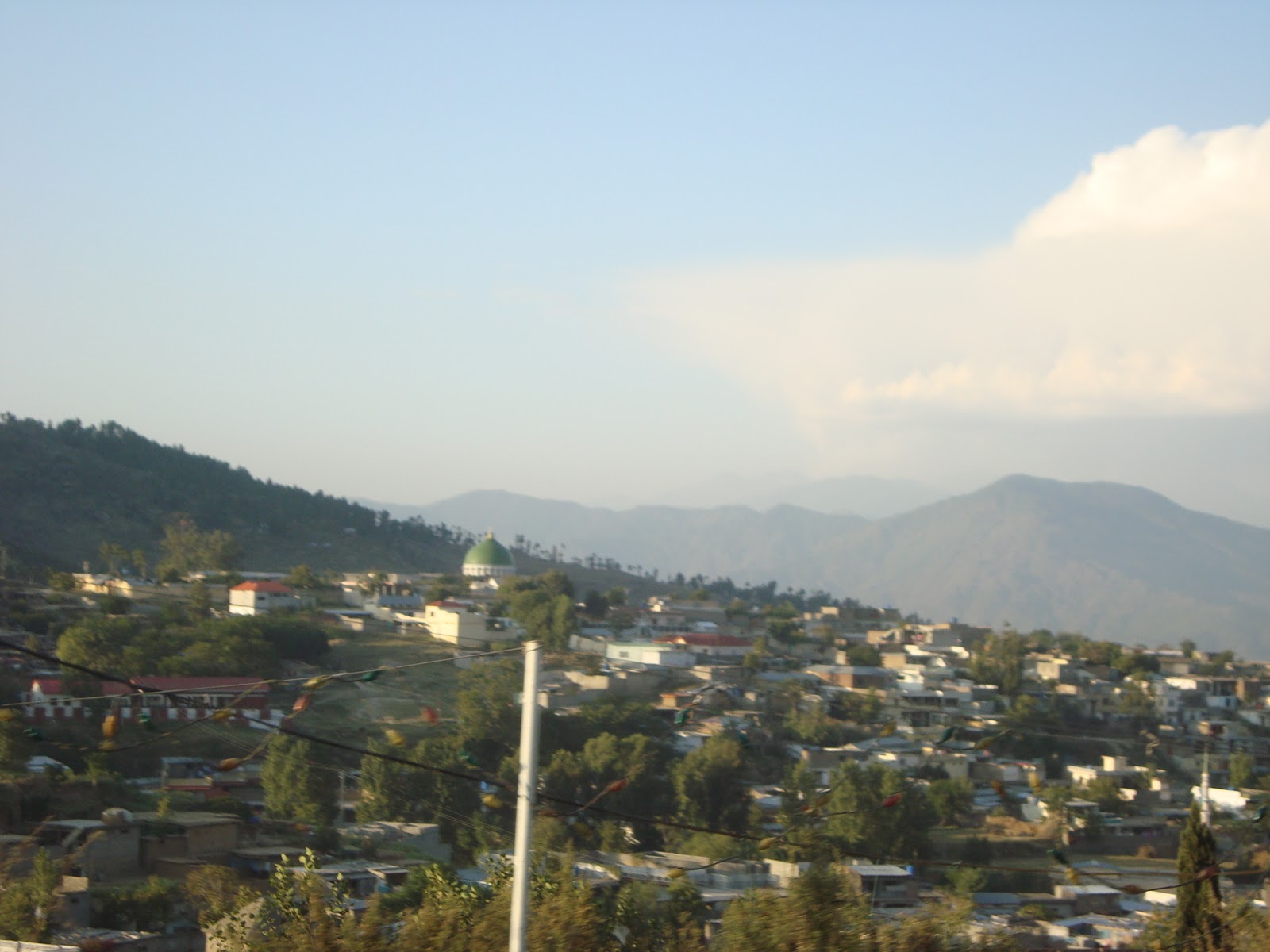 |
| The sprawling valley of Mansehra |
Night was falling fast, and as I stood there alone on the roadside in Mansehra, I saw the markets come to life. The small, cramped streets were crowded with a lot of pedestrian traffic, and the pathways wound up and down on the mountain slopes. A sms from a colleague told me that heavy traffic might delay them. So I ventured off into the inviting street markets on my own.
There were no streetlights on the cramped roads, and as I walked, lights came on inside the shops lining each side of the road. Bright bulbs, tube lights and colored signs all illuminated the place in a unique ambiance. There were all types of wares on display in these shops such as dry fruits, meat, rugs and ornaments. I could hear loud calls and shouts in Pushto from all sides as shop owners sat on their shop floors, calling out to passing people, trying to attract them to their shops. Barbers, tailors and small dhabas also lined up the one lane roads, and cars struggled to get past each other through the hustle and bustle.
The markets in Mansehra had their own charm, and as I gazed from one side of the road to the other, I noticed that I was attracting a whole lot of attention. I was perhaps the only one there dressed in a t-shirt and jeans while the others were in traditional shalwar kameez. I sat down on a bench outside a shop a little way off from the point I was left behind, and watched for nearly an hour as the simple scenes of life in this remote marketplace went past me.
The next evening, we went up the road to Shimla Hill in Abbottabad. It was a little after sunset, and night time had set in. On the way, we decided that the road was unsafe for travel all the way up after dark and we stopped the car on the hillside more than halfway up Shimla Hill. The moment I stepped out of the car and stretched my gaze up at the sky, I swear that it was one of the most, if not the most, beautiful sight I had ever seen. The sky was pure and clear and I had never seen so many stars in one place my entire life. It was like one of those photos you see on the internet from the Hubble Telescope where you can see clusters of stars with bright regions of concentration in places. So the sky first exhibited the brightest stars which are visible from every city with smog and light pollution, then behind those bright ones could be seen more stars scattered across, and behind those far away stars were bright clusters, far, far away visible as points the size of needle pricks. All this beauty filled my entire field of vision when I looked up, and the night time sky appeared more like the inside of a sphere than a plane. The weather was chilly, and the tips of pine trees were also visible, almost trying to touch the stars as well. When I turned my neck away to look below on the right, another enchanted sight opened up; the bright shimmering lights of Abbottabad glowed a few miles below us in the darkness, and the faint sound of Azaan-e-Isha could be heard from below all around us. I stood looking at the sky for the next ten minutes, mesmerized with tears in my eyes.
Much later in the evening, after dinner, we were tempted to return to Shimla Hill once more. It was past 11 PM now, and the area was fully quiet. The road going uphill was dark, and the surrounding pine trees on the slope, darker. The car stopped at the same spot again and we all sat down on the right side of the road, a few meters away from the slope going downhill. A pure feeling of peace just spread over as we looked the dotted lights of Abbottabad shining below us. A good moon had also come out now, and its silver aura spread a magical cover over the stars. Perhaps that view was only meant to be seen once in a lifetime. The intense view of the heavens visible earlier could not be seen in its full glory, but there were still enough stars up there to keep me mesmerized till dawn.
One of my colleagues, sitting next to me fueled my imagination further. She recounted the tale of someone she knew from Gilgit-Baltistan, a villager, who had told her that on the warm summer nights of the full moon, they did not sleep. He had said that they used to find a good vantage point and stayed up all night, watching the moonlight bathe the valley in silver. Time used to stop and the rivers shone bright in the night as if the whole land was suspended in a fairy tale. I could only imagine all that as we sat there for almost half an hour, undisturbed except for the occasional passing car on the road behind us.
It looked just like any other Masjid, so I inquired, “Why is this place so famous?”
 |
| Stream flowing inside Ilyasi Masjid, Abbottabad |
I had half expected it to be a natural grove inside the Masjid, where perhaps the stream flowed from an opening in a wall. However, I saw that the stream’s flow had been directed through a pipe which flowed out into an open pool, before dissipating further downhill. The ablution area also had a large open pipe in a wall where water flowed freely into a water channel made in the floor. The sound of rushing water there was simply beautiful.
“Since the 2005 earthquake, the stream has changed its course,” my colleague told me. “There used to be more water flowing through the Masjid before that. The Masjid is old, and many decades ago when much of Abbottabad used to come here for prayers, many vendors set up stalls outside.”
 |
| Ilyasi Pakora House, Abbottabad |
The place had many independent food stalls, all selling local delicacies like pakoras and samosas under the shade of tree. Many families and students all sat on plastic chairs and tables laughing and eating as the rich aroma filled the air around me. We decided to buy some pakoras before continuing to Nathia Gali.
What followed was an hour’s drive that took us higher and higher into the arms of the mountains. It was a beautiful drive surrounded by green mountain sides, and small settlements visible below us. It was late afternoon, and much of the roads were covered in the shadow of the mountain slopes around us. The route had a lot more greenery and ascent compared to the road to Mansehra. We stopped about a kilometer or so from Nathia Gali’s high street, and my colleagues started bringing out the supplies.
Their idea was to cook their own food out in the green cover of trees near the roadside instead of dining at a restaurant. A few of my accompanying colleagues cooked very well, and had brought with them spices, chicken and a portable gas stove. It should have been simple, but the altitude meant the food needed to be cooked at higher pressure, and a strong, cold wind made it difficult for the fire to get going. Myself and two others left the others at the stove, and took a stroll towards the high street.
 |
| High Street in Nathia Gali |
As darkness gathered, we headed back to the campsite. The temperature dropped fast and the sounds of nature faded away. Soon, we were just walking at on the side of the road in twilight, with the occasional headlights from a passing car illuminating the path. Our pace quickened as the road sloped downward and we turned a bend to get sight of our parked cars near the roadside. The small clearing where my colleagues had been cooking before we left was empty, and we looked around for them, puzzled. A dark form waved at us from the other side of the road, outside a small shelter. We quickened pace and saw a flicker of light coming from inside the one-roomed shelter, accompanied by sounds of laughter.
Two strangers, both men who worked at a service station just outside Nathia Gali, resided there. It appeared our chefs could not get a steady fire going in the cold outside, so the hospitable residents of the area had allowed us space to cook. The man, draped in a thick shawl, spoke in accented Urdu as he ushered us inside. Long shadows bounced off the walls amid the flicker of candle light, while two cellphone torches remained focused over a cooking pot where one of my colleagues was busy fixing dinner. The two hosts spoke between themselves in Pushto as they spread a dining mat on the floor, and offered us space to sit in the small, crowded room. We took off our shoes and settled down in their quarters.
It was a unique experience, to be out so far from home, being offered hospitality by complete strangers on a cold night in the mountains, and helping ourselves to some spicy, filling chicken. There was laughter and stories that night, and the humble hosts were more than happy to have company for dinner. As I thanked the hosts and left their quarters, the cold wind blew down Nathia Gali once more; it was now pitch black outside and the headlights of a passing car were all that illuminated the mountain road a few metres ahead. Above, the stars shone bright like they did on the night in Abbottabad. The fleeting beauty of the mountains had me mesmerized like a siren's song, and it was hard to resist its melody.
Two strangers, both men who worked at a service station just outside Nathia Gali, resided there. It appeared our chefs could not get a steady fire going in the cold outside, so the hospitable residents of the area had allowed us space to cook. The man, draped in a thick shawl, spoke in accented Urdu as he ushered us inside. Long shadows bounced off the walls amid the flicker of candle light, while two cellphone torches remained focused over a cooking pot where one of my colleagues was busy fixing dinner. The two hosts spoke between themselves in Pushto as they spread a dining mat on the floor, and offered us space to sit in the small, crowded room. We took off our shoes and settled down in their quarters.
It was a unique experience, to be out so far from home, being offered hospitality by complete strangers on a cold night in the mountains, and helping ourselves to some spicy, filling chicken. There was laughter and stories that night, and the humble hosts were more than happy to have company for dinner. As I thanked the hosts and left their quarters, the cold wind blew down Nathia Gali once more; it was now pitch black outside and the headlights of a passing car were all that illuminated the mountain road a few metres ahead. Above, the stars shone bright like they did on the night in Abbottabad. The fleeting beauty of the mountains had me mesmerized like a siren's song, and it was hard to resist its melody.